
API Integration Patterns for RPM Platforms: Developer Guide
A developer guide for Health IT directors and EHR integration teams on the primary API integration patterns for remote patient monitoring (RPM) platforms.
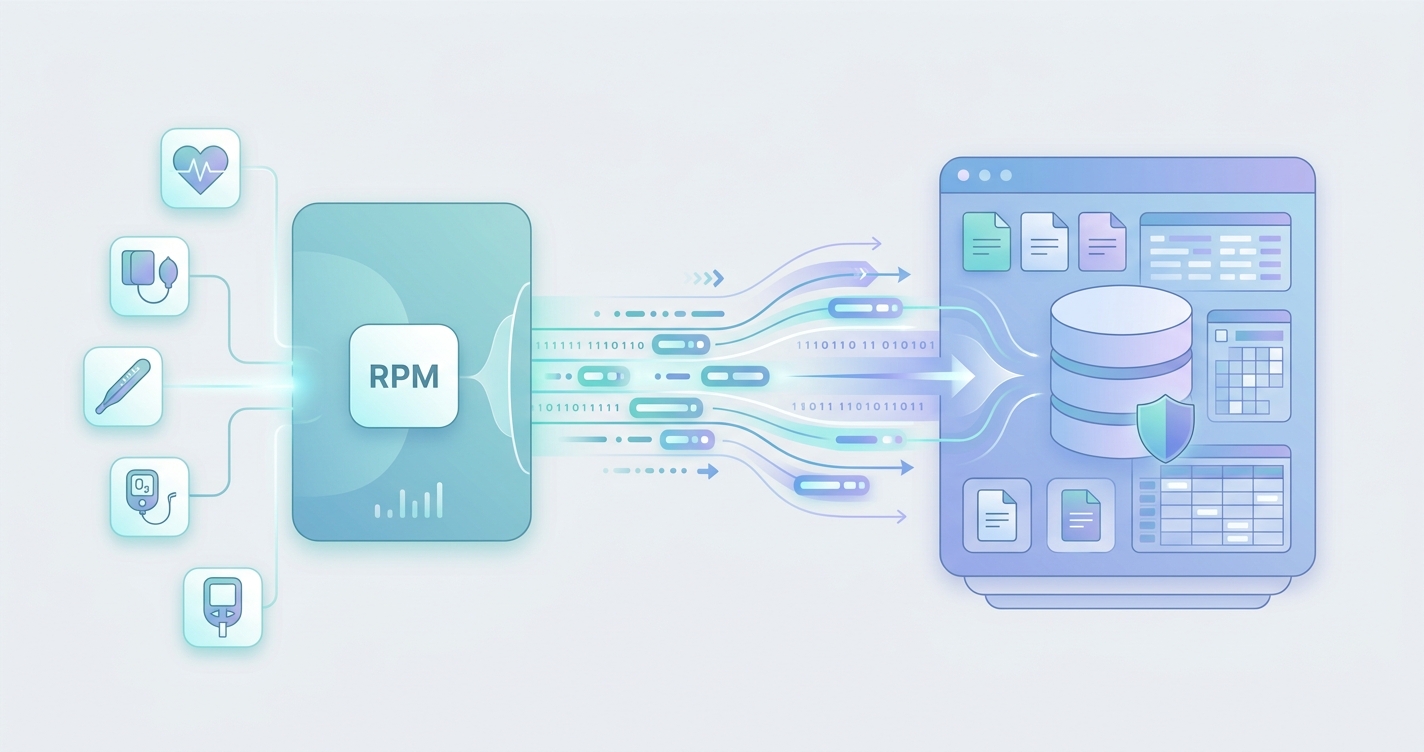
The operational effectiveness of any remote patient monitoring (RPM) program hinges on the seamless flow of data between patient-used devices, clinical dashboards, and the electronic health record (EHR). For health IT directors and integration teams, the choice of API integration patterns for RPM platforms is not merely a technical decision but a strategic one that dictates scalability, interoperability, and the total cost of ownership. As healthcare systems move beyond pilot programs to enterprise-wide RPM deployment, understanding the architectural options for data exchange is fundamental to success.
"APIs are increasingly important and strategic, carrying about 83% of all internet traffic, with 82% of organizations using them internally and 71% using third-party APIs." - Gartner, 2024
Decoding API Integration Patterns for RPM Platforms
The core challenge in RPM is managing the secure and efficient transmission of data from a heterogeneous device ecosystem to a centralized clinical platform. The chosen API integration pattern directly impacts how data is ingested, normalized, and made available for clinical decision-making. These patterns range from simple, direct connections to sophisticated, brokered architectures that use interoperability standards like HL7 FHIR. The selection process requires a careful analysis of existing infrastructure, security requirements, and long-term strategic goals for patient monitoring data. For most health IT teams, the primary goal is to establish a reliable data pipeline that minimizes manual intervention and supports real-time clinical workflows.
| Integration Pattern | Description | Pros | Cons | Best For |
|---|---|---|---|---|
| Direct API Integration | Each device or data source connects directly to the RPM platform via a custom point-to-point API. | - Simple for a small number of devices. - Low initial latency. | - Becomes complex and brittle at scale ("spaghetti architecture"). - High maintenance overhead. - Poor scalability. | Small-scale pilots or proof-of-concept projects with a limited and fixed set of devices. |
| API Gateway | A single entry point that routes API requests from various clients to the appropriate backend services. | - Centralized management of APIs. - Improved security (authentication, rate limiting). - Simplified client-side logic. | - Can become a single point of failure. - Potential for increased latency if not managed correctly. | Organizations building a formal API program and needing to expose RPM data to multiple internal or external applications. |
| Message Broker / Pub-Sub | A central broker or topic receives messages from publishers (devices) and pushes them to subscribers (RPM platform, EHR). | - Decouples data producers and consumers. - High scalability and resilience. - Asynchronous data flow handles volume spikes. | - More complex initial setup. - Guarantees of message ordering can be a challenge. | Enterprise-scale deployments with high data volumes and a need for real-time, event-driven workflows. |
| FHIR-based Integration | Uses the HL7 Fast Healthcare Interoperability Resources (FHIR) standard for data structure and exchange. | - Native interoperability with modern EHRs. - Standardized data model (e.g., Observation resource for vitals). - Strong community and tooling support. | - May require a FHIR server or translation layer for non-compliant sources. - Adoption still growing for certain device types. | Health systems committed to standards-based interoperability and seeking seamless EHR integration. |
Industry Applications
The application of these patterns depends heavily on the organization's existing technology stack and strategic priorities. A health system with a mature Epic or Cerner instance will likely prioritize FHIR-based API integration patterns for RPM platforms to ensure that vital signs data flows directly into the patient's chart as structured data.
Use Cases for Health IT and EHR Teams
- EHR Integration: A message broker pattern can be used to ingest data from hundreds of different RPM devices, normalize it, and then forward it to a FHIR server, which in turn populates the EHR. This decouples the device integration logic from the EHR integration logic.
- Telehealth Platform Enhancement: A telehealth provider might use an API Gateway to expose RPM data endpoints. This allows their core platform to pull on-demand vitals during a virtual visit, providing a richer clinical context without needing to build direct integrations to each device.
- Population Health Analytics: For population health initiatives, a pub-sub model is highly effective. As RPM devices publish data, multiple subscribers can consume it simultaneously: the clinical care team's dashboard, a research database, and a population health analytics platform.
Current research and evidence
The move towards standardized APIs is well-documented. Research and analysis from industry bodies consistently point to the strategic necessity of robust API management. Gartner's 2024 Hype Cycle for APIs places FHIR APIs near the peak of expectations, signaling their growing importance and adoption within the healthcare sector. Analysts emphasize that as AI's role in healthcare grows, its reliance on well-structured, API-accessible data will only increase. Studies on RPM implementation consistently highlight interoperability as a primary barrier to scale. A 2022 study published in the Journal of Medical Internet Research (JMIR) by researchers at the Mayo Clinic found that the lack of standardized data exchange was a significant operational challenge in their RPM programs. This highlights the critical need for adopting patterns like FHIR-based integration to ensure data liquidity.
The Future of API Integration in RPM
The future lies in creating a "composable" healthcare enterprise, where API integration patterns for RPM platforms allow new services and data sources to be added with minimal friction. We can expect to see a greater push towards "zero-touch" integration, where platforms can automatically discover, authenticate, and configure data flow from new devices using standardized protocols. The continued development of the FHIR standard, with more mature resources for continuous data streams and device management, will be a key enabler of this future. The convergence of RPM, telehealth, and in-person care data streams into a single, coherent patient view, all facilitated by sophisticated API architectures, is the clear end goal for the industry.
Frequently asked questions
Q: What is the most significant challenge when choosing an API integration pattern for an RPM platform? A: The most significant challenge is balancing short-term implementation speed with long-term scalability and interoperability. A direct, point-to-point integration might be fastest for a single device, but it creates technical debt that hinders growth. Planning for a more scalable pattern like a message broker or FHIR-based architecture from the start is often a better strategic choice.
Q: How does HL7 FHIR change the approach to RPM API integration?
A: FHIR provides a standardized language and transport mechanism for health data. Instead of every integration being a custom project, FHIR offers a common target data model (like the Observation resource for vital signs). This dramatically simplifies integrating RPM data with EHRs and other clinical systems that also "speak" FHIR, reducing development time and improving data consistency.
Q: Can a single RPM platform use multiple integration patterns? A: Yes, and it's quite common. An RPM platform might use a direct API to connect to a proprietary, high-volume device, use a message broker to ingest data from a variety of other sources, and expose a FHIR API for consumption by an EHR. This hybrid approach allows for flexibility in accommodating different data sources and integration requirements.
As the industry matures, the focus is shifting from simply collecting remote data to integrating it meaningfully into clinical workflows. Circadify is at the forefront of addressing this challenge, providing solutions built on modern, interoperable, and scalable API architectures. To learn more about how to connect your systems, explore our integration documentation and EHR guides at circadify.com/solutions/telehealth.