Can my doctor really track my heart rate from home without a wearable?
Explore the technology behind remote monitoring of vitals without wearables. A deep dive into camera-based heart rate tracking for telehealth and RPM platforms.
The paradigm of remote patient monitoring (RPM) is shifting from a device-centric model to a data and workflow-centric one. For years, RPM has been synonymous with hardware: blood pressure cuffs, glucose meters, and pulse oximeters. While effective, this approach introduces significant logistical and operational friction related to device procurement, shipping, patient setup, and data synchronization. Today, a new class of technology enabling remote monitoring vitals without wearable devices is gaining traction, using software and standard cameras to extract physiological data. This approach promises to reduce patient burden and simplify the technology stack for health IT and telehealth operations teams, but it requires a careful evaluation of its underlying mechanisms, accuracy, and integration pathways.
"The number of U.S. adults using remote patient monitoring is projected to reach 70.6 million by 2025, representing 26.2% of the population." - Insider Intelligence, 2021.
How camera-based vitals monitoring works
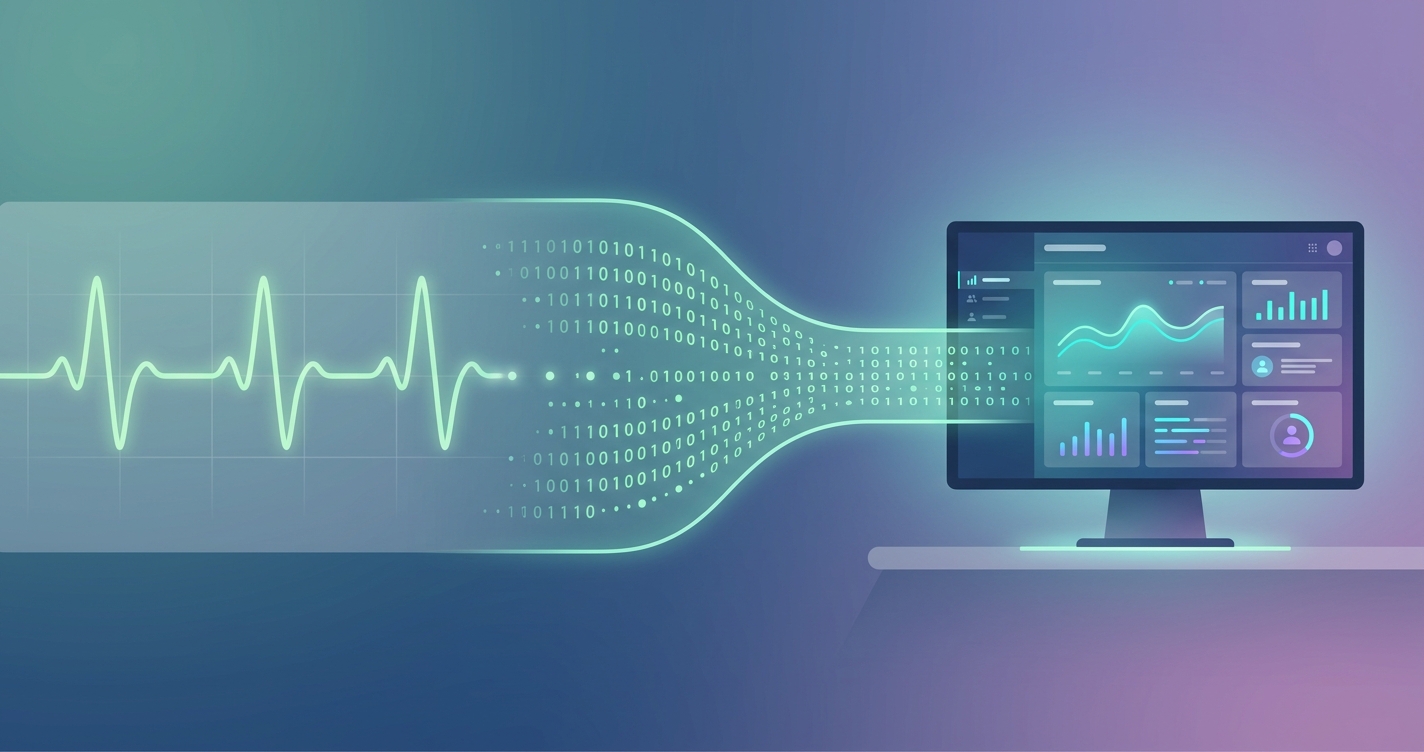
The technology that enables a doctor to track a patient's heart rate using a simple video stream is a computational technique known as remote photoplethysmography (rPPG). This method uses the camera on a smartphone, laptop, or tablet to detect subtle, imperceptible changes in light reflected from the skin. As the heart pumps, blood circulates, causing volumetric changes in the microvascular tissue of the face. These changes in blood volume alter the way light is absorbed and reflected. An rPPG algorithm analyzes the video feed frame by frame, isolating a region of interest (such as the patient's forehead or cheeks) and extracting the raw color data, typically from the green channel, as it offers the highest signal-to-noise ratio for hemoglobin absorption.
This raw signal is then processed through a series of filters to remove noise originating from motion artifacts (e.g., patient movement) and fluctuations in ambient lighting. Sophisticated signal processing and machine learning models, such as those employing Fast Fourier Transforms (FFT) or deep learning architectures, convert the filtered signal into a clean plethysmographic waveform. From this waveform, vital signs like heart rate can be calculated with a high degree of precision. The process, from video capture to vital sign output, often takes less than 30 seconds. This method of remote monitoring vitals without wearable devices represents a significant step toward frictionless data acquisition in virtual care settings.
| Feature | Traditional RPM (Wearables/Cuffs) | Camera-Based RPM (Contactless) |
|---|---|---|
| Patient Experience | Requires handling, charging, and using a physical device. | No physical device needed; uses existing smartphone or laptop. |
| Data Acquisition | Episodic; measurements are taken at discrete points in time. | Continuous or semi-continuous during a virtual visit or scan. |
| Hardware & Logistics | High overhead for procurement, shipping, and device management. | Pure software solution; minimal hardware dependency. |
| Workflow Integration | Requires device-specific APIs and data pairing. | Integrates via SDK into existing telehealth/EHR platforms. |
| Data Standardization | Varies by device vendor; may require normalization. | Typically standardized to HL7 FHIR resources (e.g., Observation). |
Industry Applications
The integration of contactless vital sign monitoring is not a standalone solution but an enhancement to existing clinical workflows. Its value is realized when the data flows seamlessly into the systems that providers already use.
Telehealth platform integration
The most immediate application is within virtual visits. Telehealth platforms can embed camera-based monitoring capabilities directly into their video interface using a software development kit (SDK). This allows a provider to initiate a vital sign scan during a live consultation, capturing objective data to complement the subjective patient interview.
- The provider clicks a button in the telehealth UI to start a scan.
- The patient is guided on-screen to position their face correctly.
- The measurement is captured and displayed to the provider in real-time.
- The data is automatically associated with the patient's record for the visit.
Chronic care management workflows
For RPM programs focused on chronic conditions like hypertension or atrial fibrillation, patients can be prompted to perform scans on a regular schedule via a patient portal or mobile app. This creates a stream of longitudinal data without the need for a dedicated wearable device. This data can power clinical decision support systems, flagging concerning trends for care manager review and intervention. The key is automating the flow of this information into care management dashboards and EHR worklists.
EHR Data Flow and FHIR Compatibility
For health IT teams, the critical question is how this data enters the electronic health record. Leading solutions for remote monitoring vitals without wearable technology are designed with interoperability in mind. The vital sign data is typically packaged as an HL7 FHIR Observation resource. This standardized format ensures that the data can be ingested by any FHIR-compliant EHR, such as Epic, Cerner, or eClinicalWorks, through established API endpoints. The FHIR resource includes The vital sign value and unit. Metadata about the measurement method (rPPG), time, and patient context, ensuring a complete and auditable record.
Current research and evidence
The viability of rPPG has been a subject of extensive academic research for over a decade. Early work by researchers like Wim Verkruysse at the University of Southern California (2008) laid the groundwork by demonstrating that photoplethysmographic signals could be measured from a distance using ambient light. Subsequent research has focused on improving accuracy and robustness.
A 2020 study led by researchers at the University of South Australia compared the accuracy of a smartphone-based rPPG application to a contact-based PPG sensor and an electrocardiogram (ECG). The findings showed a high correlation and agreement, with a mean absolute error of approximately 2.5 beats per minute compared to the ECG, deeming it acceptable for clinical use in stable conditions. Further research has explored the impact of variables like skin tone and motion. Studies by researchers like Unmukt Gupta at Stanford University (2018) have focused on developing deep learning models that are more robust to these variations, using multi-channel color information and advanced noise cancellation techniques to improve performance across diverse patient populations.
The future of remote monitoring vitals without wearable tech
The trajectory for contactless monitoring points toward expansion in both capability and application. Current commercially available technology primarily focuses on heart rate and heart rate variability. However, research is rapidly advancing toward the camera-based measurement of other key vitals, including respiratory rate, blood oxygen saturation (SpO2), and even cuffless blood pressure. As these algorithms mature and receive regulatory clearance, a single video scan could one day provide a comprehensive set of vital signs.
Furthermore, the application will likely extend beyond telehealth and RPM into new settings. Imagine hospital waiting rooms where a camera passively screens patients for fever or elevated heart rate, or in-car systems that monitor driver wellness. For health IT, this highlights the need to build a flexible data infrastructure capable of ingesting and routing high-frequency, multi-modal data from a variety of sources. The core challenge will remain the same: transforming raw data into clinically actionable insights within the provider's workflow.
Frequently asked questions
Q: How accurate is remote monitoring of vitals without a wearable? A: In controlled settings, camera-based rPPG methods have demonstrated accuracy comparable to conventional pulse oximeters for measuring heart rate, often with a mean absolute error of 2-4 beats per minute against an ECG reference. Accuracy can be influenced by factors like patient motion, poor lighting, and certain skin tones, but modern algorithms are increasingly effective at mitigating these variables.
Q: What are the technical requirements for implementing camera-based vitals? A: From the patient's perspective, the requirements are minimal: a device with a standard digital camera (like a smartphone or laptop) and an internet connection. On the provider side, the health system or telehealth platform must integrate a software development kit (SDK) into their existing application. This SDK handles the video processing and algorithmic calculations.
Q: How does contactless vital sign data integrate with our Epic or Cerner EHR? A: The standard integration pathway uses HL7 FHIR. The data captured via the camera is converted into a FHIR Observation resource. This resource is then transmitted to the EHR's FHIR API endpoint, where it can be filed into the patient's chart, often appearing in flowsheet rows just like data from traditional medical devices.
Q: Is this technology secure and HIPAA compliant? A: Yes, when implemented correctly. The video stream is processed in real-time and is typically not stored. The resulting numerical data (e.g., heart rate) is encrypted and transmitted through secure channels, and the entire workflow is managed within a HIPAA-compliant environment, just like any other piece of protected health information (PHI).
The journey from a patient-facing camera to a provider-facing dashboard is complex, but the underlying technology is now mature. The primary barrier to adoption is no longer feasibility but integration. Circadify specializes in providing the infrastructure to connect novel data sources like camera-based monitoring into established clinical systems. To learn more about how to embed these capabilities into your telehealth or RPM platform, explore our integration documentation and EHR guides at circadify.com/solutions/telehealth.