Before it's too late, how can my doctor see my health changes from home every day?
How daily remote monitoring lets a doctor see health changes home before they escalate, and what the EHR integration architecture behind early detection requires.
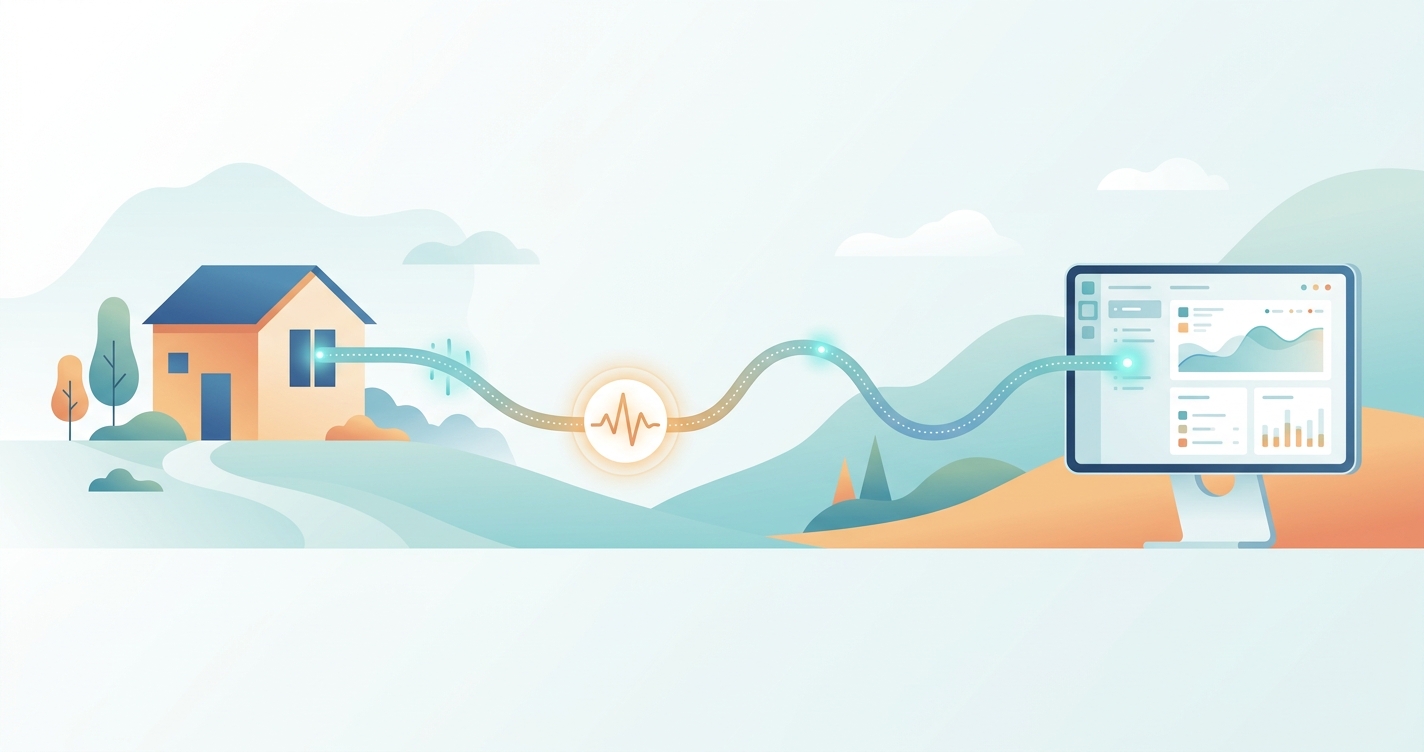
The most consequential question patients ask their care teams is rarely technical. It sounds like worry: before it is too late, how can my doctor see my health changes from home every day? Behind that plain-language request sits one of the harder engineering problems in modern care delivery. For a doctor to see health changes home produces, the daily readings a patient captures on a kitchen table have to travel through a device, a transport layer, a normalization pipeline, and an EHR, then surface inside a clinical workflow at the exact moment a trend becomes actionable. Health IT directors and EHR integration teams own that journey end to end. The clinical promise of early detection is only as real as the plumbing that carries the data.
A large-scale analysis of Michigan Medicine's Patient Monitoring at Home program (November 2020 to August 2022) found a 59 percent reduction in average hospital admissions over six months across conditions including congestive heart failure, hypertension, and COVID-19. The signal that prevents an admission only matters if it reaches a clinician in time.
Why a doctor needing to see health changes home is an integration problem
When patients enrolled in chronic care imagine remote monitoring, they picture a doctor watching a dashboard. The operational reality is that no clinician watches anything continuously. Early detection works because software flags a meaningful deviation, routes it to the right person, and documents the response inside the same record where the rest of the patient's history lives. The ability for a doctor to see health changes home generates therefore depends less on the measurement device and more on data latency, normalization, and where the alert lands.
Consider the failure modes that quietly defeat early detection programs:
- Readings sit in a vendor portal that nobody logs into between scheduled visits.
- Values arrive in a proprietary format that never maps cleanly to a discrete EHR field, so trends cannot be charted.
- Alert thresholds are static and generic, producing so much noise that genuine deterioration is buried.
- Weekend and overnight readings queue without an escalation path, delaying response by days.
Each of these is an architecture decision, not a clinical one. The Tan et al. systematic review published in npj Digital Medicine in 2024 reported consistent gains in patient safety and treatment adherence across remote monitoring interventions, but those gains were concentrated in programs where data integration and follow-up workflows were deliberately engineered rather than bolted on.
Comparing data delivery models for early detection
How a reading reaches a clinician determines whether early detection is theoretical or operational. The table below compares the common delivery models health IT teams evaluate.
| Delivery model | Time to clinician visibility | EHR integration depth | Early detection capability | Operational burden |
|---|---|---|---|---|
| Vendor portal only | Hours to days (manual login) | None; data siloed | Low; reactive | Staff must check externally |
| PDF or fax summary | Days; periodic batches | Document only, not discrete | Very low | High manual reconciliation |
| HL7 v2 flowsheet feed | Minutes to hours | Discrete values, limited context | Moderate | Interface engine upkeep |
| FHIR Observation API | Near real time | Discrete, coded, queryable | High; supports trending and CDS | Lower with standards-based design |
| FHIR plus rules-based alerting | Near real time with triage | Discrete plus decision support | Highest; proactive escalation | Tuning required to limit fatigue |
The pattern is consistent: the closer a program moves toward standards-based, discrete, coded data with intelligent alerting, the sooner a doctor can see health changes home reveals and the lower the long-term operational drag. FHIR-based delivery is not just a compliance preference; it is what makes the daily trend chartable, comparable, and usable by clinical decision support.
Industry applications across the care continuum
Chronic disease management
The most mature use of daily home monitoring is chronic disease. HealthSnap's 2024 Clinical Outcomes Report, associated with Wesley Smith, Ph.D., found that more than 80 percent of hypertensive patients lowered their blood pressure, with type II diabetic patients seeing a 16.5 mg/dL reduction in fasting blood glucose. Those outcomes depend on a care team noticing a drift in weekly averages, not a single dramatic value. For an EHR integration team, the requirement is trendable time-series data tied to the patient's problem list and medication record.
Post-discharge transitions
The highest-risk window is the 30 days after discharge. A prospective cohort study published in 2024 found that home digital monitoring reduced average hospitalizations from 0.45 to 0.19 at three months and emergency department visits from 0.48 to 0.06 over the same period. The integration imperative here is speed: a post-discharge patient's deterioration can move from subtle to acute within hours, so near real time delivery and an explicit escalation path are non-negotiable.
Heart failure and high-acuity cohorts
Heart failure remains the canonical early detection case because daily weight and vital trends predict decompensation before symptoms force a hospital visit. A 2025 meta-analysis on remote monitoring in heart failure concluded that monitoring significantly reduced heart failure-related hospitalizations. Translating that into practice requires alert logic sensitive enough to catch a multi-day weight trend yet specific enough to avoid drowning nurses in false positives.
Current research and evidence
The evidence base has matured from pilot anecdotes to multi-site analyses with hard utilization endpoints. Several findings are directly relevant to teams designing the data path:
- Hospitalization reduction scales with program size and integration depth, per the Michigan Medicine analysis covering 2020 to 2022.
- A retrospective analysis of a remote patient care program from July 2022 to October 2023 found a statistically significant reduction in total cost of care and hospitalizations among Medicare patients with chronic disease.
- The Tan et al. 2024 review in npj Digital Medicine linked outcome gains to adherence and safety, both of which depend on consistent data capture and clinician follow-up.
- The global remote monitoring market, estimated at 14 billion dollars in 2023, is projected to reach 41.7 billion by 2028, driven partly by hospital-at-home expansion.
The throughline across these studies is that the clinical benefit is real but conditional. The programs that move utilization metrics are the ones where data reaches the EHR as discrete, coded, timely information that a clinician or a rules engine can act on. Programs that leave data stranded in portals report engagement without outcomes.
The future of daily home health monitoring
Three shifts will define the next several years of letting a doctor see health changes home in near real time.
- Contactless and ambient capture will lower the friction that drives patient drop-off, increasing the density of daily readings available for trending.
- Decision support will move upstream, with risk models running against streaming FHIR Observations rather than waiting for a clinician to open a chart.
- Reimbursement and interoperability requirements will continue to converge, making standards-based data exchange a prerequisite for both payment and clinical value.
For health IT leaders, the strategic implication is to treat the data path as the product. The device a patient uses will change. The EHR may be upgraded. What endures is the integration pattern: standards-based, discrete, timely, and wired into an escalation workflow. Build that once and the next generation of monitoring inputs plugs in without re-architecting the whole pipeline.
Frequently asked questions
What does it actually take for a doctor to see health changes from home every day?
It takes a continuous data path: a home measurement, transmission over a secure transport layer, normalization into a standard format such as FHIR Observation resources, and delivery into the EHR where the value is charted and, ideally, evaluated by alerting rules. The clinician sees a trend and an exception flag, not a raw stream they must monitor manually.
Why is near real time delivery important for early detection?
Because deterioration in high-risk patients, particularly after discharge or in heart failure, can progress within hours. Published studies show the largest reductions in hospitalizations and emergency visits occur when readings reach a care team quickly enough to intervene before a small change becomes an acute event.
How does FHIR integration help versus a vendor portal?
A vendor portal isolates data outside the clinical workflow, so it is only seen when staff log in separately. FHIR delivers discrete, coded values directly into the EHR, where they can be trended over time, compared against history, and processed by clinical decision support. That is the difference between reactive review and proactive early detection.
Can alert fatigue undermine the benefit?
Yes. Generic, static thresholds generate excessive false positives that mask genuine deterioration. Effective programs tune alert logic to patient-specific baselines and route exceptions through a defined escalation path, preserving sensitivity without overwhelming staff.
Circadify is working on this exact space, focused on making home-generated vitals arrive as HL7 FHIR data that plugs into existing EHR and telehealth workflows so early signals reach clinicians without custom rebuilds. For integration documentation and EHR guides, see circadify.com/solutions/telehealth.