How can I be sure my doctor sees my home readings before my next appointment?
How RPM data flow, EHR integration, and clinical review workflows make sure your doctor sees home readings before your next appointment.
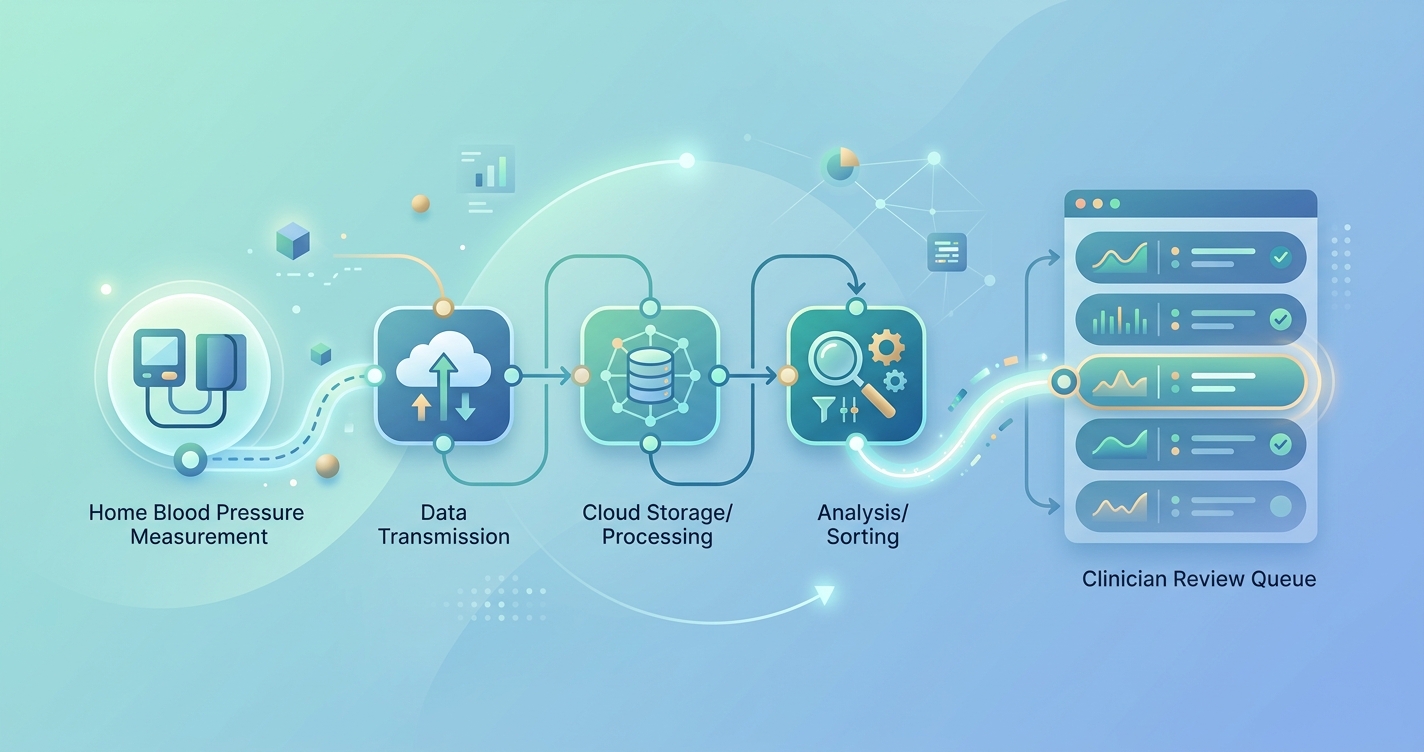
A patient who measures blood pressure at the kitchen table on a Tuesday morning is, without realizing it, starting a multi-step data journey that ends at a clinician's worklist. The reassurance that a doctor sees home readings before the next appointment is not a matter of luck or a single helpful nurse remembering to check. It is the output of a deliberate data pipeline: device capture, transport, normalization, mapping into the electronic health record, and routing into a review queue with defined ownership. For health IT directors and telehealth operations teams, the question patients ask in plain language is the same question that governs program design behind the scenes. Whether home data gets actioned in time depends entirely on how that pipeline is engineered and monitored.
A 2024 systematic review of remote patient monitoring interventions published in PMC found that RPM programs improved safety and quality-of-life outcomes primarily when monitoring data was integrated into clinical workflows rather than reviewed in isolation. Integration, not collection, was the differentiator.
Why patients worry whether the doctor sees home readings
The anxiety is rational. In many early RPM deployments, device data landed in a vendor portal that lived outside the EHR. Clinicians had to remember to log into a separate system, manually transcribe values, and reconcile them against the chart. Data sat unreviewed not because anyone was negligent, but because the workflow created friction at every handoff. When the goal is to guarantee a doctor sees home readings before an appointment, the architecture has to remove those handoffs.
Modern RPM workflow integration solves this by treating the home reading as a structured clinical observation from the moment it is captured. According to FHIR integration guidance summarized by Helixbeat (2024), standardizing health data exchange between devices and EHRs reduces the delays that occur when records live in separate systems, which is where late diagnoses and missed warnings originate. The Fast Healthcare Interoperability Resources standard lets a home blood pressure value travel as a FHIR Observation resource, arriving in the EHR with the right patient identifier, timestamp, unit, and code already attached.
The practical effect is that the reading appears in the same flowsheet and review queue a clinician already uses for in-clinic vitals. There is no separate login, no transcription, and no reconciliation gap. Timely review becomes the default rather than the exception.
Comparing data flow models that determine review timeliness
The path a home reading takes is the single biggest predictor of whether it is reviewed before the next visit. The table below contrasts the common architectures health IT teams encounter.
| Data flow model | Latency to EHR | Review mechanism | Risk that data is missed |
|---|---|---|---|
| Isolated vendor portal | Hours to days | Manual portal login | High |
| Batch CSV export to EHR | Daily or scheduled | Manual chart upload | Moderate to high |
| HL7 v2 interface feed | Minutes to hours | Flowsheet entry | Moderate |
| FHIR Observation API | Near real time | Native worklist plus alerts | Low |
| FHIR plus rules-based routing | Near real time | Triaged queue with ownership | Lowest |
The pattern is straightforward. The fewer manual steps between capture and the clinician's worklist, the more reliably the doctor sees home readings in time to act. FHIR-based delivery paired with rules-based routing closes the loop because each reading is Delivered. Assigned to a named reviewer or escalation path.
Key factors that influence whether a reading is reviewed before an appointment:
- Transport latency from device to the integration engine
- Whether values map cleanly to FHIR Observation resources without manual cleanup
- Existence of a review queue with explicit clinical ownership
- Alert thresholds that surface abnormal readings ahead of routine ones
- Reconciliation logic for multi-device or multi-vendor data
Industry applications across the review workflow
EHR integration teams
For integration teams, the reassurance patients want maps directly to interface design. Mapping home vitals to FHIR Observation resources gives each reading a LOINC code, a unit of measure, and a subject reference, which means the EHR can file it into the correct flowsheet automatically. The work is in the mapping tables and the conformance testing, not in asking clinicians to chase data. When done well, a home reading taken Sunday is already on the Monday morning worklist.
Telehealth operations
Operations teams own the human side of review. CMS reimbursement structure makes this concrete: under CPT codes 99457 and 99458, RPM treatment management requires at least 20 minutes of clinical staff or provider time per calendar month, with interactive communication, as detailed by Foley and Lardner (2024). That billing requirement only works if data reliably reaches a reviewer. Operations teams build the monitoring rosters, define who reviews which queue, and set the cadence that ensures readings are seen well before a scheduled visit, not scrambled together the night before.
Care management programs
Care managers act on what the pipeline delivers. When abnormal readings are flagged and routed, a care manager can intervene between visits rather than waiting for the appointment. This is where the patient question shifts from being seen to being acted upon. The 2024 PMC systematic review noted that intervention value depended on data being embedded in clinical workflows, which is precisely the care management layer.
Current research and evidence
Evidence consistently points to integration as the variable that matters. The 2024 systematic review in PMC on RPM safety, adherence, and cost outcomes concluded that programs delivered measurable benefit when monitoring data flowed into clinical decision-making rather than sitting in parallel systems. Separately, research on integrating RPM data into machine learning models for predicting emergency department utilization, also published in PMC, found that EHR-integrated RPM data improved the predictive accuracy of risk models, which only holds if the data arrives complete and structured.
On the standards side, FHIR adoption is the connective tissue. Industry analysis from Helixbeat (2024) describes how SMART on FHIR integrations reduce data redundancy and support faster clinical decision-making by giving clinicians real-time access inside their existing tools. The reimbursement evidence reinforces the operational stakes: with CPT 99457 reimbursing roughly 48 dollars and 99458 roughly 39 dollars per the 2024 CMS schedule reported by Foley and Lardner, programs have a financial reason to ensure data is reviewed and documented, and patients benefit from that alignment of incentives.
The broader market context matters too. With the global RPM market projected to reach 41.7 billion dollars by 2028 according to figures cited across 2024 industry reporting, the volume of home readings entering EHRs is climbing sharply, which makes automated, FHIR-based review pipelines a necessity rather than an enhancement.
The future of doctor review for home readings
The next phase moves from delivery to intelligent prioritization. As reading volume grows, the constraint is no longer getting data into the EHR but surfacing the readings that need attention first. Expect tighter coupling between FHIR ingestion and clinical decision support, so that a worklist is ordered by clinical urgency rather than chronology. Patients will increasingly receive confirmation that a reading was received and routed, closing the trust gap that the original question reflects.
CMS has also signaled movement toward lower time thresholds and additional billing flexibility for remote monitoring, which would broaden the range of programs that can sustain timely review workflows. As those rules evolve, the architecture that guarantees a doctor sees home readings will become standard infrastructure across chronic care, not a feature of advanced programs alone. The destination is a system where the patient never has to wonder whether their data was seen, because confirmation and review are built into the flow.
Frequently asked questions
How does my home reading actually reach my doctor's chart? The device captures the reading and transmits it to an integration engine, which converts it into a standardized FHIR Observation with your patient identifier, timestamp, and units. That structured record files into the same flowsheet your clinician uses for in-office vitals, so it appears on their worklist without manual entry.
Will an abnormal reading get attention faster than a normal one? In well-designed programs, yes. Rules-based routing and clinical decision support flag readings outside set thresholds and push them into a priority queue or trigger an alert, so concerning values are surfaced ahead of routine ones rather than waiting for a scheduled review.
Does anyone have to be assigned to review my data, or does it just sit there? Timely review depends on explicit ownership. Telehealth operations teams build monitoring rosters that assign each data queue to a named reviewer. CMS billing for RPM treatment management requires at least 20 minutes of clinical time per month, which gives programs a structural reason to ensure data is actively reviewed.
What happens if my clinic uses several different monitoring devices? Multi-vendor data is handled by reconciliation logic in the integration layer, which normalizes readings from different devices into consistent FHIR resources. This prevents duplicates and gaps so your full picture reaches the chart regardless of which device captured a given reading.
Circadify is building RPM data delivery that plugs into existing EHR and telehealth workflows using HL7 FHIR compatible vital signs data, so home readings reach the right review queue before the next appointment. Explore the integration documentation and EHR guides at circadify.com/solutions/telehealth.