How can my family doctor use my home health data to help me stay healthier longer?
How home health data benefits primary care: RPM feeds personalized care plans, sharpens chronic disease management, and gives family doctors a continuous clinical picture.
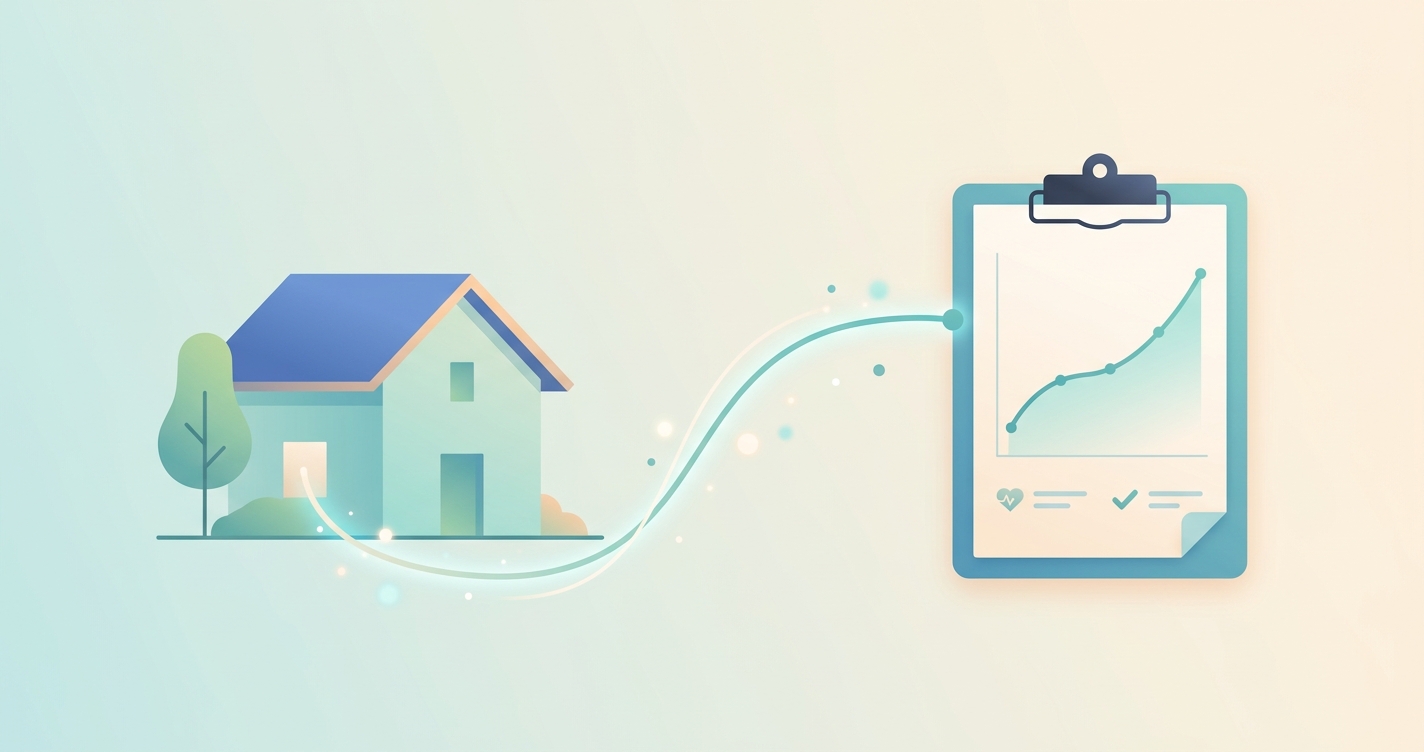
A family doctor seeing a patient twice a year is making decisions from roughly four hours of observation across a 8,760-hour calendar. That sampling gap is the structural weakness in primary care, and it is the reason a single elevated reading in an exam room can be misread as either alarming or meaningless. Remote patient monitoring (RPM) closes the gap by streaming blood pressure, glucose, weight, and pulse data from the home into the same systems clinicians already use. For health IT directors and EHR integration teams, the question is no longer whether the data exists, but whether it lands in the chart in a form a physician can act on. That is where the real home health data benefits begin, and where integration architecture determines clinical value.
A 2024 retrospective cohort analysis published in PMC found that systolic blood pressure improved by 7.3 mmHg across all patients enrolled in an RPM program for at least 90 days, and by 16.7 mmHg for patients with stage 2 hypertension.
The home health data benefits that change primary care
The clinical advantage of home-collected data is not a single dramatic reading. It is the trend. A physician who can see thirty consecutive morning blood pressure measurements is reasoning from a distribution rather than a snapshot, which changes how medication is titrated, how risk is stratified, and how soon a deterioration is caught. The home health data benefits compound over time: longitudinal vitals let a doctor distinguish white-coat hypertension from sustained disease, detect medication non-adherence through erratic patterns, and intervene before a chronic condition produces an acute event.
For this to work, the data has to be trustworthy and it has to be in the workflow. A reading that sits in a vendor portal the physician never opens delivers no benefit. The technical objective for integration teams is to map device output to discrete, queryable fields in the EHR, typically through HL7 FHIR Observation resources, so that home vitals appear alongside in-clinic vitals rather than as an attachment or a fax. The clinical objective is preventive: convert continuous signal into earlier, smaller, cheaper interventions.
The contrast below frames why continuous home data outperforms episodic clinic visits for chronic disease management.
| Dimension | Episodic clinic visits | Continuous home health data |
|---|---|---|
| Data frequency | 2-4 readings per year | Daily or multiple readings per week |
| Context of measurement | Clinical setting, white-coat effect | Resting, real-world conditions |
| Trend visibility | Limited, point-in-time | Longitudinal, pattern-based |
| Early deterioration detection | Often after symptoms appear | Before acute events |
| Care plan adjustment cadence | Per appointment | Continuous, data-triggered |
| Medication adherence insight | Self-report only | Inferred from reading patterns |
| EHR documentation | Manual entry | Automated via FHIR mapping |
The shift this table describes is operational as much as clinical. Moving from the left column to the right requires that the data pipeline preserve provenance, timestamp, and units so a physician trusts the number enough to change a prescription based on it.
What family doctors actually do with the data
When home data reaches the chart cleanly, primary care teams use it in a few recurring ways:
- Titrate antihypertensive and diabetes medications against real trends instead of isolated office readings.
- Flag patients whose morning weights are climbing, an early signal of heart failure fluid retention, before an emergency department visit.
- Confirm or rule out white-coat hypertension, avoiding both overtreatment and missed diagnoses.
- Prioritize panel outreach so nursing staff call the patients whose data shows drift, not the whole roster.
- Document time-based monitoring activity that supports CMS RPM reimbursement without manual chart-hunting.
Each of these depends on the integration team delivering data that is discrete, attributed, and reconciled across devices.
Industry Applications
Chronic disease management
Hypertension, type 2 diabetes, and heart failure are the conditions where continuous home data produces the clearest return. An updated 2021 meta-analysis of 32 studies on remote blood pressure monitoring reported a weighted mean systolic reduction of 4.46 mmHg and a diastolic reduction of 2.08 mmHg versus usual care, with a higher overall control rate. For a primary care panel of several thousand patients, a population-level shift of that magnitude meaningfully lowers downstream cardiovascular and renal risk.
Preventive and risk-stratified care
Home data lets care teams move resources toward patients trending in the wrong direction. Instead of treating every patient on the same recall schedule, a practice can use incoming vitals to trigger outreach only when readings cross a threshold. This is the operational core of preventive care: catch the slow decline while it is still reversible with a phone call and a dose change.
Post-discharge and transitional care
The 30 days after a hospital discharge are the highest-risk window for readmission. Daily home vitals during that window give the family doctor or care manager a live view of recovery, surfacing fluid retention, blood pressure instability, or glucose swings early enough to redirect care to the clinic rather than the hospital.
Current research and evidence
The evidence base for home health data has matured from feasibility pilots to outcome studies. A 2023 Mass General Brigham study published in JAMA Network Open described a remote monitoring program that reduced both blood pressure and cholesterol, lowering modeled cardiovascular disease risk. The 2024 retrospective cohort cited above quantified a 7.3 mmHg average systolic improvement, with the largest gains among the highest-risk patients, exactly the group preventive programs aim to reach.
Two qualifications matter for integration teams reading this evidence. First, benefits scale with monitoring frequency, so pipeline reliability and patient adherence directly affect clinical outcomes. Second, research on remote hypertension monitoring has also noted increased short-term costs from intensified treatment and medication use, which means the financial case rests on avoided downstream events rather than immediate savings. The data architecture that supports both the clinical and the billing narrative is therefore the same: complete, timestamped, discrete records mapped into the EHR.
The recurring theme across the literature is that outcomes track data quality and workflow fit, not device novelty. A program collecting clean FHIR-mapped vitals into a physician's daily view will outperform one collecting more data into a portal nobody checks.
The Future of home health data benefits
The next phase moves from raw trends to interpreted signal. Three developments are already underway. First, clinical decision support is beginning to filter the firehose of home readings so physicians see prioritized exceptions rather than every measurement, reducing alert fatigue. Second, contactless and passive capture methods are lowering the adherence barrier that has historically capped the value of home monitoring, since the most reliable data comes from patients who do not have to learn a new device. Third, standardization on FHIR Observation resources is making home data portable across health information exchanges, so a patient's longitudinal record follows them between providers.
For health IT leaders, the strategic implication is that home health data is becoming a permanent input to the longitudinal record, not a bolt-on service line. Building the ingestion, mapping, and reconciliation layer now positions a health system to absorb whatever capture technology comes next without re-architecting.
Frequently asked questions
What are the main home health data benefits for chronic disease patients?
The primary benefits are earlier detection of deterioration, medication titration based on real-world trends rather than single office readings, and reduced acute events. Studies report meaningful systolic blood pressure reductions and improved control rates when home data is used continuously in care plans.
How does home health data reach my family doctor's chart?
Device readings are transmitted to an RPM platform, mapped to standardized fields such as HL7 FHIR Observation resources, and integrated into the EHR so they appear alongside in-clinic vitals. Proper mapping preserves the timestamp, units, and source needed for a physician to act on the data.
Does more home monitoring data actually improve outcomes?
Research indicates benefits increase with monitoring frequency and consistent use. The clinical value depends heavily on data quality and whether the readings reach the physician in a usable form, which is why integration architecture matters as much as the devices themselves.
Why do health IT teams care about FHIR for home health data?
FHIR provides a consistent structure for vital signs, making home data discrete, queryable, and portable across systems and health information exchanges. This lets home readings flow into existing clinical and billing workflows without custom point-to-point builds for each device.
Circadify is addressing this space by delivering FHIR-compatible RPM data that plugs into existing EHR and telehealth workflows, so home readings become usable clinical signal rather than stranded portal data. Integration teams evaluating how to operationalize these benefits can review the integration docs and EHR guides at circadify.com/solutions/telehealth.