
How Health Information Exchanges Work With RPM Data
A deep dive into the technical and operational models for HIE RPM data exchange, including the role of interoperability standards like HL7 FHIR in connecting remote monitoring data with broader health information networks.
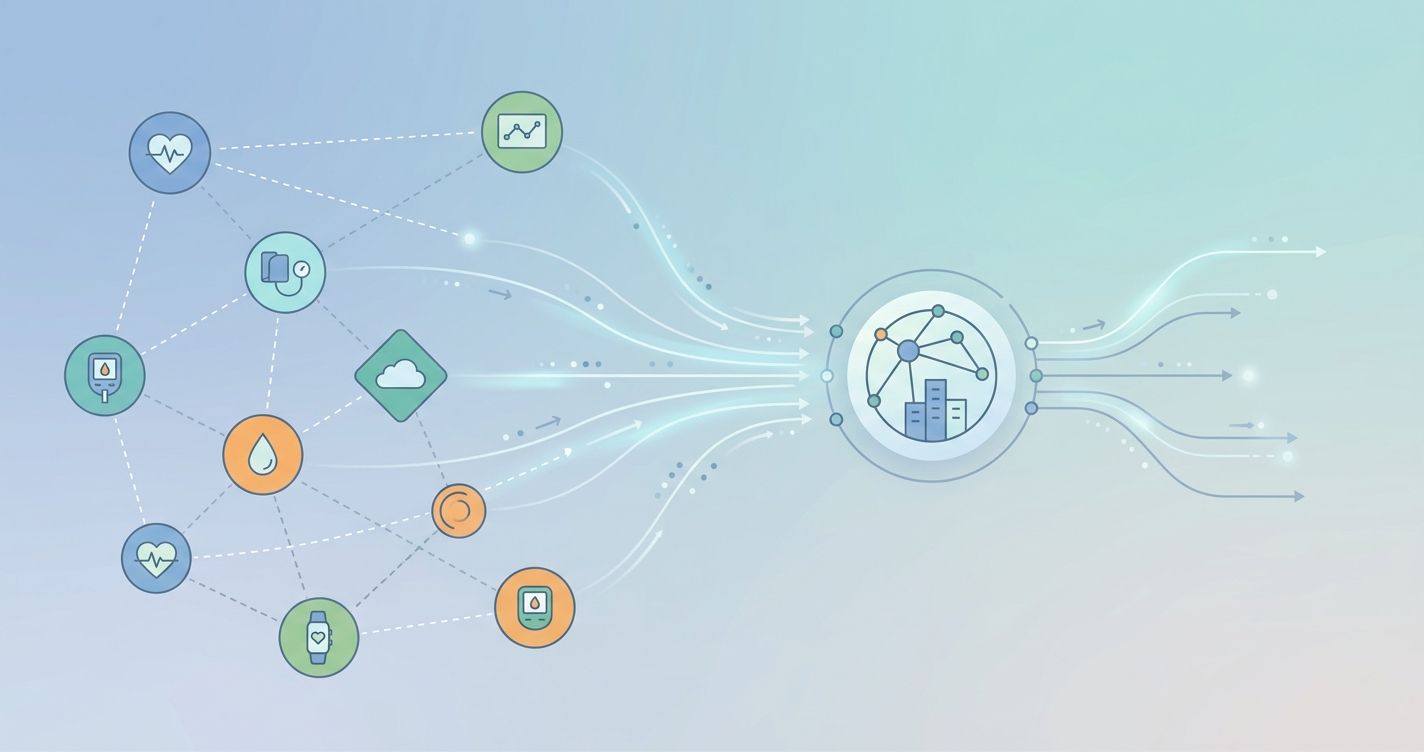
Remote Patient Monitoring (RPM) has moved beyond a niche telehealth service to a fundamental component of modern care delivery, generating a continuous stream of vital patient data. However, the full clinical and operational value of this data is often unrealized, trapped within the silos of standalone RPM platforms. The critical challenge for health IT teams is not just collecting the data, but effectively integrating it into the broader patient record. This is where the strategic implementation of a Health Information Exchange (HIE) becomes critical, providing the architectural foundation for a scalable and interoperable HIE RPM data exchange that can transform care coordination and population health.
"A 2022 survey by the Office of the National Coordinator for Health Information Technology (ONC) found that 93% of hospitals now participate in a state, regional, or national health information network, yet the integration of patient-generated health data, including RPM data, remains a significant barrier to realizing the full potential of these networks."
The Architecture of HIE RPM Data Exchange
The primary function of an HIE is to facilitate the secure electronic movement of health-related information among disparate healthcare organizations. When applied to RPM, the HIE acts as a central conduit, normalizing and routing patient-generated data from various monitoring devices to the appropriate clinical systems, most notably the Electronic Health Record (EHR). The success of this process hinges on robust interoperability standards. While HL7 FHIR (Fast Healthcare Interoperability Resources) has emerged as the leading standard for modern API-based integration, the HIE RPM data exchange ecosystem also relies on other established protocols. These include HL7 V2 messaging for event-driven updates and Consolidated CDA (C-CDA) for document-based exchange.
At its core, the HIE RPM data exchange can operate through several models. A "push" model involves the RPM platform proactively sending alerts and data summaries to the HIE when certain clinical thresholds are met. A "pull" or "query-based" model allows authorized providers to retrieve a patient's RPM history from the HIE on demand. A more advanced, event-driven model uses publish-subscribe patterns, where clinical systems subscribe to specific data types for a patient, receiving real-time updates as new RPM data is available. This technical framework is the key to breaking down data silos and ensuring that timely RPM data is available at the point of care.
| Data Exchange Model | Description | Primary Use Case | Key Technology |
|---|---|---|---|
| Centralized Repository | All participating organizations send data to a single, central data store managed by the HIE. | Comprehensive, longitudinal patient records. | Master Patient Index (MPI), Large-scale database. |
| Federated (Decentralized) | The HIE acts as a query broker, connecting to individual provider systems to retrieve data in real-time. Data remains at the source. | On-demand data retrieval without a central data warehouse. | Secure messaging, API gateways, Record locator service. |
| Hybrid Model | A combination of centralized and federated approaches, often storing a basic MPI and recent data centrally while querying for older or specialized data. | Balancing speed of access with data source control. | MPI, API gateways, Edge data caches. |
| Event-Driven (Pub/Sub) | Systems subscribe to notifications about specific patients or data types (e.g., critical vital signs), receiving real-time alerts. | Critical alert notification, real-time workflow triggers. | FHIR Subscriptions, Messaging Queues (e.g., Kafka). |
Industry Applications
The integration of RPM data into HIEs opens up new possibilities for proactive and efficient care delivery across multiple domains.
Population health management
Health systems can use aggregated, de-identified RPM data from the HIE to identify trends and risks within specific patient populations. For instance, analyzing blood pressure and glucose data across a diabetic population can help stratify patients who are at high risk for acute events, allowing for targeted interventions. This macro-level view is impossible when RPM data is confined to individual platforms.
Clinical decision support
When RPM data flows through an HIE into the primary EHR, it can be used to power Clinical Decision Support (CDS) tools. A physician seeing a patient for a pre-operative consult could receive an automated alert based on a trend of declining oxygen saturation levels captured by an RPM device at home over the past week, information that would otherwise be missed. This makes the HIE RPM data exchange a critical enabler of proactive, data-driven clinical practice.
Care coordination and transitional care
A primary cause of hospital readmissions is the lack of timely information flow as a patient transitions from inpatient to home care. By connecting the hospital's EHR, the patient's home monitoring devices, and the primary care physician's system through an HIE, care teams can get a unified view of the patient's recovery. If a post-surgical patient's weight, captured by a cellular-enabled scale, suddenly increases, an alert can be routed via the HIE to a care manager to intervene before the condition escalates to a full-blown emergency.
Current research and evidence
Recent studies highlight both the progress and the persistent challenges in achieving widespread HIE-enabled RPM data sharing. Research conducted by scholars from the University of South Carolina, published in JMIR Medical Informatics in 2023, analyzed HIE participation in South Carolina from 2014 to 2020. The study found a significant increase in hospital participation over the seven-year period but noted that technical and financial barriers continued to hinder the exchange of more complex data types like those from remote monitoring. The Office of the National Coordinator for Health Information Technology (ONC) has consistently promoted HIE adoption, emphasizing benefits such as reduced medication errors, fewer duplicate tests, and improved patient safety. Their analyses show that while foundational data exchange is common, the advanced, semantically interoperable exchange required for seamless HIE RPM data exchange is still an evolving capability for many networks.
Key findings from industry reports also show that while the majority of healthcare organizations see the value in integrating RPM data, most struggle with the workflow and technical integration. This "last mile" problem is where modern, FHIR-native platforms and HIEs provide the most value, offering standardized APIs and data models that abstract away the complexity of device-specific data formats.
The Future of HIE and RPM Integration
The trajectory of healthcare interoperability points towards a more connected and intelligent future for RPM data. The implementation of the 21st Century Cures Act and the Trusted Exchange Framework and Common Agreement (TEFCA) in the United States is accelerating the push towards nationwide, secure data exchange. This will create new pathways for RPM data to flow not just between a patient and their provider, but across entire health systems, public health agencies, and even with patient consent, to research institutions. Furthermore, the integration of artificial intelligence and machine learning algorithms within HIE services promises to add a layer of predictive analytics on top of the raw RPM data, identifying at-risk patients with even greater accuracy and providing clinicians with actionable insights, not just more data.
Frequently asked questions
Q: What is the difference between an HIE and an EHR? A: An EHR (Electronic Health Record) is a digital record of a patient's health information from a single healthcare provider, like a hospital or a doctor's office. An HIE (Health Information Exchange) is a secure network that allows different providers and organizations to share and access patient information from multiple sources, including other EHRs and RPM platforms.
Q: How does HL7 FHIR help with HIE RPM data exchange? A: HL7 FHIR provides a standardized, API-first approach for representing and exchanging healthcare information. For RPM data, this means there is a common language and technical specification for things like blood pressure (Observation resource) and patient information (Patient resource). This dramatically simplifies the process of integrating data from diverse RPM devices into an HIE and then into an EHR, making the HIE RPM data exchange more efficient and scalable.
Q: Who governs a Health Information Exchange? A: HIEs are typically governed by a collaborative of stakeholders within a geographic region or state. This can include hospitals, physician practices, public health departments, and sometimes payers. They operate under a set of legal agreements and technical standards to ensure data is shared securely and in compliance with regulations like HIPAA.
As healthcare organizations increasingly rely on remote monitoring to manage patient populations, the need for a robust HIE RPM data exchange strategy has become a critical infrastructure requirement. The ability to seamlessly integrate device data into clinical workflows is no longer a technical nicety but a core competency for delivering efficient and effective care. For health IT teams evaluating how to scale their RPM programs, focusing on platforms built for interoperability is the key. Circadify is at the forefront of addressing this space, offering solutions designed to connect with existing EHR and telehealth workflows. To learn more, explore our integration documentation and EHR guides at circadify.com/solutions/telehealth.