What if my internet goes out; will my doctor still get my vital signs later?
How offline vital signs upload, local queuing, and FHIR synchronization protect RPM data integrity when patient connectivity drops. A guide for health IT teams.
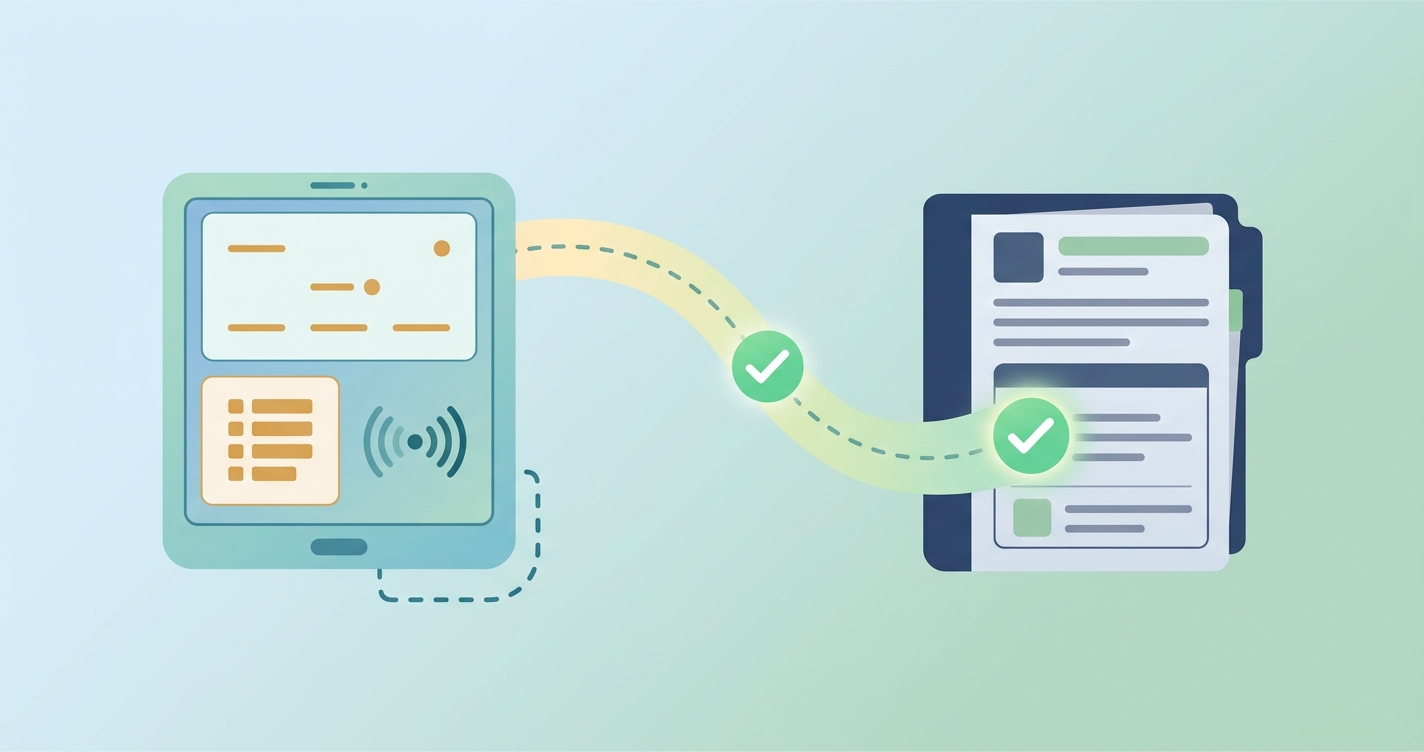
A patient takes a blood pressure reading at the kitchen table on a Sunday morning, sees a green checkmark on the device, and goes about their day. Two hours later their home internet drops for the afternoon. The clinical question they ask their care team is simple: will my doctor still get this number? The engineering question behind it is the one health IT directors and EHR integration teams actually have to answer. Reliable offline vital signs upload is not a feature patients should have to think about. It is an architectural guarantee built into the data path so that a connectivity gap becomes a delay measured in minutes, never a permanent loss of a clinical observation.
A 2024 FCC report found that nearly 23 percent of rural Americans and 24 percent of those on Tribal lands still lack access to fixed broadband, compared with roughly 2 percent in urban areas. For any RPM program serving these populations, intermittent connectivity is the default condition, not the exception.
Why offline vital signs upload defines RPM reliability
The reflex assumption in remote monitoring is that a device captures a reading and immediately transmits it to a server, which forwards it to the EHR. In practice, that synchronous model is fragile. Cellular signal fades, home Wi-Fi reboots, a router loses power, and a mobile hotspot exhausts its data allowance. When transmission is tied to the moment of capture, every one of those events destroys a clinical data point.
A resilient design decouples capture from transmission entirely. The reading is written first to a durable local queue on the device or companion app, then a background synchronization service uploads it whenever a connection returns. This is the same store-and-forward principle that underpins asynchronous telehealth, an approach whose adoption grew sharply between 2020 and 2024 as programs learned that not every clinical exchange needs to happen in real time. The patient sees confirmation the instant the reading is saved locally, because from a clinical-integrity standpoint the data is already safe. The upload is a separate, retryable event.
This matters because connectivity faults are common, not rare. Industry analyses of RPM programs report that connectivity and battery issues account for roughly 30 percent of device failures, and that nearly one in five programs experience device-related interruptions within the first six months of deployment. A program built on synchronous-only transmission inherits all of that fragility as silent data loss. A program built on local queuing absorbs it.
The table below contrasts the two transmission models that integration teams evaluate.
| Dimension | Synchronous-only transmission | Store-and-forward with offline queue |
|---|---|---|
| Behavior on connectivity loss | Reading fails or is dropped | Reading persisted locally, uploaded on reconnect |
| Patient experience | Error message, retry burden | Immediate local confirmation |
| Data integrity risk | High during outages | Low; bounded by local storage capacity |
| Timestamp fidelity | Capture time only if it succeeds | Capture time preserved separately from upload time |
| Duplicate risk | Low | Requires idempotency keys to prevent duplicates |
| Suitability for rural deployments | Poor | Strong |
| Audit traceability | Limited | Full queue and sync logs |
A robust offline pipeline depends on a handful of design decisions that should appear in any RPM vendor evaluation:
- Durable local persistence that survives app restarts and device reboots, not just in-memory buffering.
- Separate capture timestamps and transmission timestamps, so the clinical record reflects when the reading actually occurred.
- Idempotency keys or client-generated identifiers so a retried upload never creates a duplicate observation.
- Exponential backoff and jitter on retries to avoid thundering-herd uploads when a network returns and many devices reconnect at once.
- Encryption of queued data at rest, since readings may sit on the device for hours before upload.
- Server-side acknowledgment before the local record is marked as synced, closing the loop on delivery.
Industry applications across the integration stack
Device and edge layer
At the edge, the priority is never losing the reading in the first place. Bluetooth Low Energy peripherals and camera-based capture both hand their output to a local application that commits the observation to durable storage before attempting any network call. The queue must be bounded and managed: a device offline for a week should not exhaust its storage, and the sync service should preserve chronological order so trends arrive intact rather than scrambled.
Transport and middleware layer
The middleware is where retry logic, deduplication, and backpressure live. When connectivity is restored across a fleet, the platform may receive a surge of queued readings. Rate limiting, queue-based ingestion, and idempotent endpoints keep that surge from overwhelming downstream systems. This is also where data is normalized before it reaches the clinical record.
EHR integration layer
For the EHR team, the integration contract is what counts. Mapping each queued reading to an HL7 FHIR Observation resource, with effectiveDateTime set to the original capture moment and a separate recorded timestamp for ingestion, preserves clinical meaning regardless of upload delay. FHIR-compatible RPM data flowing through this layer lets a delayed reading land in the correct chronological position in a flowsheet, so a Sunday measurement uploaded Monday still reads as a Sunday measurement. Without that timestamp discipline, late-arriving data corrupts trend analysis and alerting.
Current research and evidence
The evidence base points in two directions at once: connectivity gaps are persistent, and asynchronous architectures are the practical answer. The 2024 FCC broadband data quantifies the gap, with the agency's March 2024 redefinition of broadband to 100/20 Mbps leaving roughly 45 million Americans below the standard. The discontinuation of the Affordable Connectivity Program in June 2024 removed a subsidy that had helped many monitored patients stay online, and researchers at UC Santa Barbara documented that rural internet service often faded once federal funding ended. For program designers, the takeaway is that patient connectivity cannot be assumed.
On the architecture side, work on implementing store-and-forward telehealth within home-based RPM programs has shown that asynchronous capture and delayed review preserve clinical value when real-time transmission is not feasible. Engineering analyses of RPM application architecture consistently recommend writing readings to a local queue before transmission and running a background service to upload on reconnection, precisely because connectivity and battery faults are among the most frequent failure modes. The convergence is clear: the reliability problem is well understood, and the mitigation, durable local queuing with idempotent synchronization, is a settled pattern rather than an experimental one.
What remains uneven is implementation. Not every platform exposes the timestamp fidelity, deduplication guarantees, and sync audit logs that integration teams need to trust the pipeline. Those properties belong on the requirements list during procurement, not discovered after go-live.
The future of offline vital signs upload
Three shifts are shaping where this goes next. First, edge resilience is improving as more processing moves onto the device, allowing readings to be validated and even pre-screened locally before any network is available. Second, multi-path connectivity, where a device falls back from Wi-Fi to cellular to a paired phone hotspot, is becoming standard, shrinking the windows during which queuing is the only option. Third, FHIR Subscriptions and more expressive synchronization APIs are maturing, which will make reconciling late-arriving data with the clinical record more automatic and less dependent on custom integration code.
The destination is a system where the patient never has to wonder whether a reading made it through, because the answer is structurally always yes, just sometimes later. For health IT teams, designing for that guarantee now avoids the far more expensive work of explaining missing data points after a program has scaled.
Frequently asked questions
If my internet is out when I take a reading, is the data lost? No, provided the platform uses local queuing. A well-designed system writes the reading to durable storage on the device first and uploads it automatically once connectivity returns. The data waits safely in the meantime, and the original capture time is preserved.
Will a delayed upload show the wrong time in my doctor's record? It should not. Proper implementations record the capture timestamp separately from the upload timestamp and map the capture time to the FHIR Observation effectiveDateTime. A Sunday reading uploaded on Monday appears in the record as a Sunday reading.
How do programs avoid duplicate readings when uploads retry? By assigning each reading a client-generated identifier or idempotency key. When the upload retries after a failure, the server recognizes the identifier and stores the observation only once, so retries never inflate the data.
What should EHR integration teams require from an RPM vendor on this? Ask for durable offline persistence, separate capture and ingestion timestamps, idempotent upload endpoints, server-side delivery acknowledgment, encryption of queued data at rest, and accessible sync audit logs. These properties determine whether you can trust the data after a connectivity gap.
Circadify is building toward this standard of resilience, with FHIR-compatible RPM data designed to queue offline and synchronize cleanly into existing EHR and telehealth workflows. For integration documentation and EHR guides, visit circadify.com/solutions/telehealth.