
Phone Camera Vitals vs Bluetooth Devices: RPM Compared
A technical comparison of camera vitals vs bluetooth RPM devices on accuracy, logistics, and cost for EHR integration and telehealth operations teams.
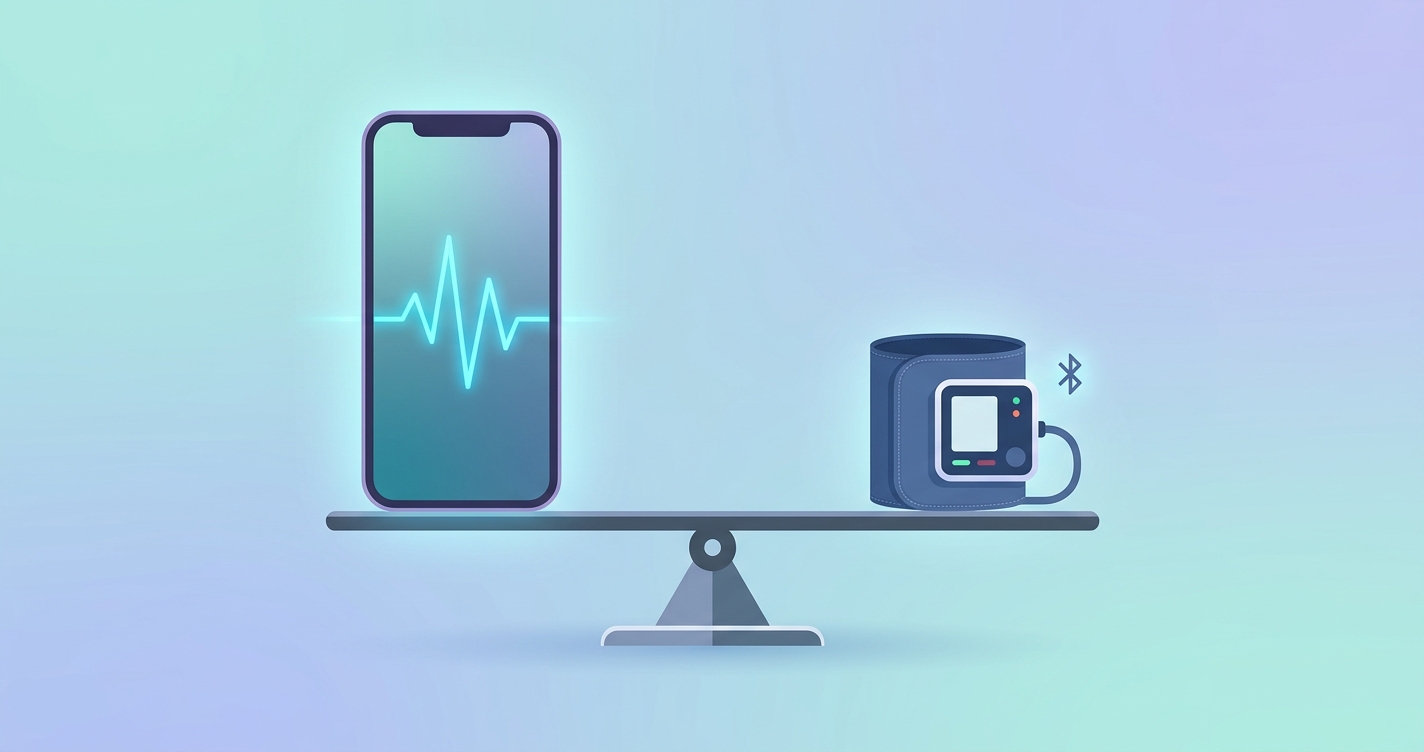
Health IT teams evaluating remote patient monitoring (RPM) capture methods now face a choice that was not on the table a few years ago: continue shipping Bluetooth peripherals to every enrolled patient, or route some measurements through a smartphone or tablet camera. The decision is rarely about novelty. It comes down to accuracy budgets, device logistics, per-patient cost, and how cleanly each source maps into the electronic health record. Understanding the tradeoffs in camera vitals vs bluetooth RPM devices is the first step toward designing a data pipeline that survives audit, scales past a pilot cohort, and feeds clean observations into clinical workflows.
A non-contact photoplethysmography mobile application achieved up to 99.1% accuracy for heart rate in 2023 validation testing, while systolic and diastolic blood pressure accuracy ranged from only 56.0% to 61.3% in the same class of studies. Source: non-contact PPG mobile application validation, 2023 (PMC).
Camera vitals vs bluetooth RPM devices: how the two capture models differ
The two approaches diverge at the sensor. Bluetooth peripherals, such as cellular blood pressure cuffs, pulse oximeters, and weight scales, use dedicated medical-grade hardware that transmits a discrete reading over a paired connection. Camera-based capture relies on remote photoplethysmography (rPPG), an optical technique that infers physiological signals from subtle color changes in facial skin as blood volume shifts with each heartbeat. The camera method requires no shipped hardware, only a device the patient already owns and a guided capture session inside an app or browser.
That difference cascades into every downstream decision. Bluetooth peripherals produce a single, well-characterized number with a known measurement standard behind it. Camera capture produces a software-derived estimate whose quality depends on lighting, motion, skin tone representation in the training data, and the patient's stillness during the reading. For health IT leaders, the practical question is not which method is universally better, but which vital signs and which patient cohorts each method serves without degrading data quality.
Contactless vital signs measurement is strongest where the underlying signal is periodic and well-defined. Research summarized by camera-based rPPG reviews in 2023 and 2024 consistently shows heart rate as the most reliable camera-derived metric, with blood pressure remaining an ill-conditioned estimation problem because pulse waveform features map to pressure values with high ambiguity.
| Factor | Camera Vitals (rPPG) | Bluetooth Peripherals |
|---|---|---|
| Hardware shipped to patient | None; uses patient device | Cuff, oximeter, scale per patient |
| Per-patient device cost | Effectively $0 incremental | $50 to $200+ per device |
| Heart rate accuracy | High; up to ~99% in app studies | High; reference-grade sensors |
| Blood pressure accuracy | Moderate; ~56-61% in mobile studies | High; oscillometric standard |
| Onboarding friction | Low; download or open link | Moderate; pairing and education |
| Reverse logistics | None | Device return and reconciliation |
| Best fit cohort | Broad screening, wellness checks | Chronic disease, billing-grade BP |
| FHIR mapping | Observation with device-software provenance | Observation with device UDI provenance |
Accuracy tradeoffs by vital sign
The accuracy gap is not uniform across vitals. Treating it as a single number hides where each method actually fails.
- Heart rate: Camera capture performs near reference standard in controlled conditions, but accuracy drops sharply at elevated heart rates and in poor lighting, according to 2023 rPPG validation work.
- Blood pressure: Bluetooth oscillometric cuffs remain the defensible source for billing-grade BP. Camera-derived BP estimates carry wide error bands and are better positioned for trend screening than for medication titration decisions.
- Oxygen saturation: Both methods can report SpO2, but contact oximetry retains an edge in low-perfusion patients.
- Respiratory rate: Camera methods handle this well because chest and facial micro-movements are directly observable.
The operational implication is a tiered data model. Many programs land on camera capture for high-frequency, low-stakes engagement readings and Bluetooth peripherals for the specific measurements that drive reimbursement and clinical escalation.
Logistics and cost: where the models separate most
For RPM device costs, the contrast is stark. CMS reimbursement under CPT 99454 paid roughly $50 per month in 2024 for device supply and daily transmissions, which means a shipped peripheral has to justify its acquisition cost, fulfillment, and return handling against that recurring code. Industry pricing for RPM hardware commonly falls between $50 and $200 per device, with some specialized units higher.
No-device remote monitoring removes several line items at once:
- Procurement and inventory carrying costs disappear.
- Direct-to-patient shipping and activation support shrink.
- Reverse logistics, the often-ignored cost of recovering devices from disenrolled patients, goes to zero.
- Replacement cycles for lost or damaged hardware no longer apply.
Bluetooth programs, by contrast, carry a fulfillment operation that scales linearly with enrollment. Each new cohort means more units, more shipping, and more reconciliation. The camera model scales closer to a software cost curve, which is why operations teams running large screening populations find it attractive even when they keep peripherals for clinical subsets.
Industry Applications
Chronic disease management
Hypertension and heart failure programs lean on billing-grade blood pressure and weight, where Bluetooth peripherals remain the dependable source. Camera capture can supplement these programs with frequent heart rate and respiratory checks between cuff readings, increasing data density without adding hardware.
Population health and screening
Large-panel screening is where no-device remote monitoring earns its keep. A primary care network running wellness checks across tens of thousands of patients cannot economically ship a cuff to everyone. Camera-based heart rate and respiratory screening lowers the cost of touching the entire panel, with peripherals reserved for flagged individuals.
Telehealth visit augmentation
During a video visit, camera capture can produce objective vitals inside the existing session, turning a subjective check-in into a documented observation. This matters for telehealth operations teams trying to attach structured data to encounters that previously generated none.
Current research and evidence
The peer-reviewed picture is consistent. Non-contact PPG mobile application studies reported in 2023 (PMC) found heart rate accuracy reaching 99.1%, while blood pressure accuracy stayed in the 56.0% to 61.3% range. Camera-based rPPG reviews published by OAE Publishing in 2023 and 2024 describe blood pressure estimation from pulse waveforms as an ill-conditioned problem driven by low mutual information between the signal and the target pressure value. Separate analyses note that rPPG accuracy degrades at elevated heart rates and under suboptimal lighting, which is why production systems impose capture-quality gates.
For integration teams, the evidence points to a provenance requirement rather than a verdict. FHIR vital signs data sources should carry method metadata so that a camera-derived heart rate and a cuff-derived blood pressure are distinguishable in the record. Mapping both into FHIR Observation resources with clear device and software provenance lets clinicians and analytics layers weight the data appropriately. The RPM market, projected by Grand View Research toward substantial growth through the end of the decade, will likely include both capture models for years, making clean source labeling a durable design need rather than a temporary one.
The future of RPM capture methods
The trajectory favors hybrid architectures over a single winner. Camera capture will keep improving as signal processing and machine learning narrow the blood pressure gap, but the near-term reality is a division of labor: cameras for broad, frequent, low-friction engagement metrics, and Bluetooth peripherals for the readings that must withstand clinical and billing scrutiny. The integration challenge shifts from choosing a device to reconciling multiple sources into one coherent patient record. Teams that build their FHIR observation model around method provenance now will absorb new capture technologies without re-engineering the pipeline later.
Frequently asked questions
Are camera-based vitals accurate enough for RPM billing?
For heart rate and respiratory rate, camera capture performs well in controlled conditions. For blood pressure, mobile rPPG studies show accuracy in the 56 to 61 percent range, so most programs still use Bluetooth cuffs for billing-grade blood pressure and reserve camera capture for screening and engagement.
How do camera vitals and Bluetooth readings appear differently in an EHR?
Both can map to FHIR Observation resources, but the provenance differs. Bluetooth devices carry a unique device identifier, while camera readings carry software and method metadata. Labeling the capture method lets clinical and analytics systems weight each value correctly.
What is the real cost difference between the two models?
Bluetooth peripherals add $50 to $200 per patient plus shipping, activation support, and device return handling. Camera capture has effectively zero incremental hardware cost because it uses devices patients already own, which is why screening programs at scale favor it.
Can a program use both capture methods together?
Yes, and most mature programs do. A tiered model uses camera capture for frequent low-stakes readings and Bluetooth peripherals for measurements that drive escalation or reimbursement, with both sources reconciled into a single patient timeline.
Circadify is building toward this hybrid reality, helping EHR integration and telehealth operations teams route both contactless and peripheral vitals into HL7 FHIR compatible workflows with consistent provenance. To see how contactless vitals fit alongside existing peripherals, review the integration docs and EHR guides at circadify.com/solutions/telehealth.