RPM Patient Onboarding Workflow: Setup Without Adding Staff
How telehealth ops teams build a repeatable RPM patient onboarding workflow that hits the 16-day data requirement without new hires or added headcount.
Most remote monitoring programs do not stall because the technology fails. They stall at the front door. A patient agrees to enroll, a device ships, and then nothing transmits for two weeks because no one confirmed activation, captured consent, or scheduled the first reading. The result is a roster that looks full on paper while billing falls short of the threshold that makes the program financially viable. A disciplined RPM patient onboarding workflow is what separates a program that scales from one that quietly leaks revenue and staff hours. For telehealth operations teams, the harder question is how to build that workflow as a repeatable system rather than a one-off scramble that demands new hires every time enrollment volume climbs.
The number of Medicare enrollees receiving remote patient monitoring nearly doubled to roughly 970,000 by 2024, with Medicare and Medicare Advantage RPM reimbursements exceeding $500 million in the same year, according to market analysis summarized across industry reporting.
Designing an RPM patient onboarding workflow that scales
An effective RPM patient onboarding workflow is a sequence of deterministic steps, each with a clear owner, a completion signal, and a fallback. The goal is to compress the time between a patient saying yes and a device transmitting its first qualifying reading, because that gap is where attrition concentrates. When the steps are loosely defined, every enrollment becomes a manual judgment call, and manual judgment is exactly what forces teams to add headcount as volume grows.
The constraint shaping every Medicare-eligible program is the data requirement attached to CPT codes 99453 and 99454. For 2024 and 2025, the Centers for Medicare and Medicaid Services requires at least 16 days of data transmission within a 30-day period for device supply and data transmission to be billable. That rule does not apply to the treatment management codes 99457 and 99458, but it governs the setup and supply codes that anchor program economics. An onboarding flow that does not reliably produce 16 transmitting days inside 30 is not just inefficient, it is unbillable.
The 2026 outlook changes the math but not the discipline. CMS has proposed new codes that would allow billing for data collected over 2 to 15 days in a 30-day period, easing the rigid threshold for lower-volume monitoring. Even with a relaxed floor, the same workflow principles apply: confirm consent, confirm activation, confirm transmission, and detect silence early.
The table below contrasts an ad hoc enrollment process with a structured one across the dimensions that drive both cost and compliance.
| Workflow dimension | Ad hoc onboarding | Structured onboarding workflow |
|---|---|---|
| Consent capture | Verbal, inconsistently documented | Templated, timestamped, stored in the EHR |
| Device activation | Patient self-starts, no confirmation | Confirmed activation event before day one |
| Time to first reading | 7 to 14 days, often unknown | 24 to 72 hours, tracked |
| 16-day threshold tracking | Reviewed at month end | Monitored continuously with day-count alerts |
| Staffing model | Linear with patient volume | Decoupled from volume through automation |
| Drop-off detection | Discovered at billing | Flagged within 48 hours of silence |
The core steps of a remote monitoring enrollment process
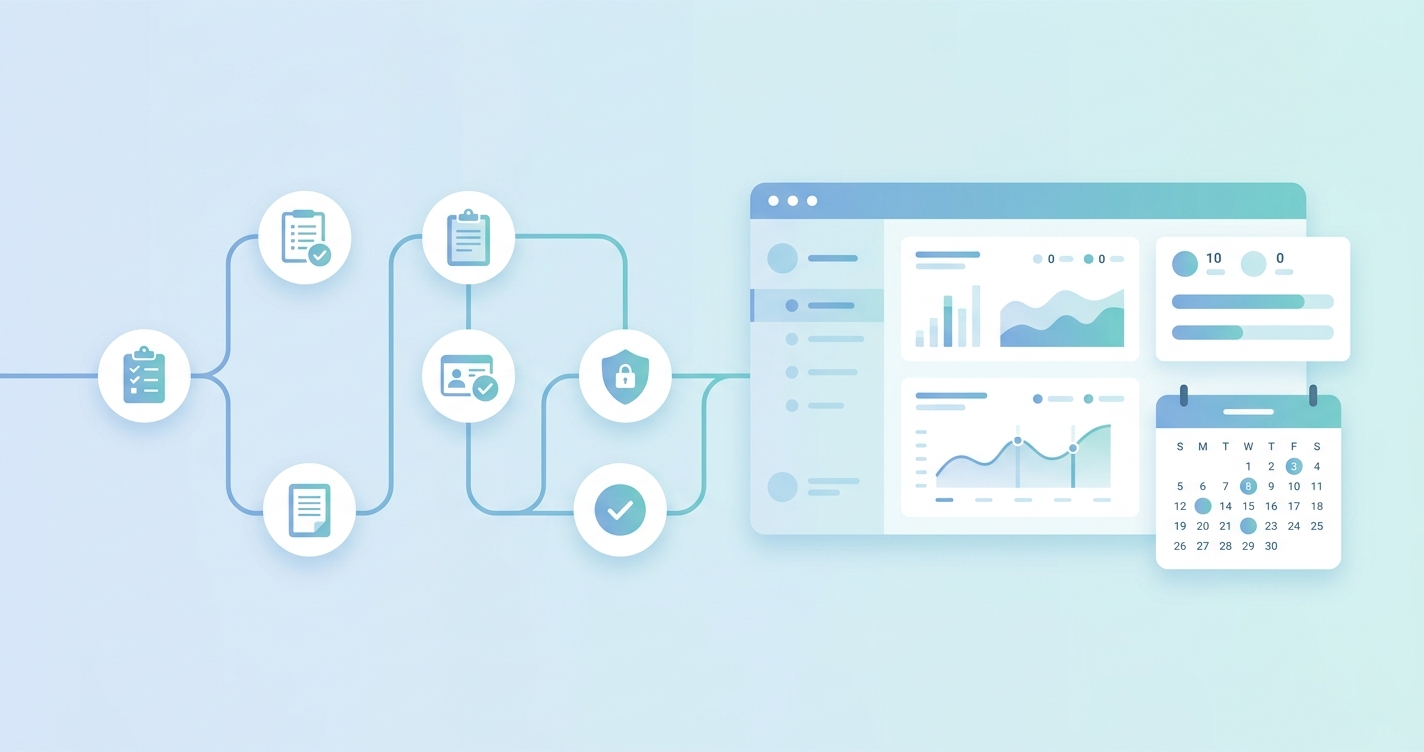
A repeatable remote monitoring enrollment process can be reduced to a small number of stages that any operations team can instrument and audit. The point is not to add ceremony but to make each handoff observable so problems surface in hours rather than at the end of the billing cycle.
- Eligibility and identification: flag qualifying patients from the EHR problem list and recent encounters rather than relying on referral memory.
- RPM consent workflow: present the consent language, capture agreement, and write a timestamped record back to the chart so it is auditable and reusable.
- Device provisioning and RPM patient setup: pre-pair or pre-configure devices so the patient's first action produces a transmission, not a troubleshooting call.
- Activation confirmation: treat the first successful reading as a discrete milestone with its own status, not an assumption.
- Engagement monitoring: track the running count of transmitting days against the 30-day window and intervene on silence.
- Billing readiness: surface which patients have crossed the 16-day line and which are at risk, before the cycle closes.
Each of these steps can be triggered, confirmed, and escalated through existing telehealth and EHR tooling. That is the mechanism by which a program decouples enrollment volume from staff count: the workflow does the routing and the humans handle exceptions.
Industry applications across telehealth operations
Chronic care programs at scale
Hypertension and diabetes programs generate the highest enrollment volumes, and they are where structured telehealth onboarding steps pay off fastest. When consent, provisioning, and activation are templated, a small care team can manage hundreds of active patients because their attention is reserved for the patients who stop transmitting rather than for routine setup. The day-count logic also matters clinically, since a patient who is not sending readings is not being monitored regardless of billing status.
Health systems integrating through FHIR
For health IT and EHR integration teams, the onboarding workflow is also a data-modeling problem. Consent artifacts, device assignments, and the stream of vital sign readings all need a consistent representation inside the record. Aligning RPM data to HL7 FHIR resources lets the onboarding milestones live in the same system clinicians already use, which removes the parallel spreadsheets that quietly require their own staff to maintain. When activation status and transmitting-day counts are queryable data rather than tribal knowledge, the workflow becomes auditable.
Multi-site and virtual-first practices
Distributed practices feel onboarding friction most acutely because no single coordinator sees the whole pipeline. A standardized RPM patient setup process, with the same consent template and the same activation milestone across every site, gives operations leaders one dashboard instead of many inboxes. That consistency is what makes the program legible to compliance reviewers and to finance.
Current research and evidence
Evidence from primary care implementation studies points to a consistent set of facilitators and barriers. Research published in PMC on the challenges and facilitators of implementing remote patient monitoring in primary care found that digital and health literacy among patients frequently extend the onboarding burden on clinicians, and that streamlined enrollment with clear educational materials is among the strongest predictors of sustained engagement. The practical reading is that onboarding friction is not evenly distributed, so workflows should route low-literacy patients to higher-touch support while letting straightforward enrollments run on autopilot.
Market data reinforces why the operational stakes keep rising. The US remote patient monitoring market was valued at roughly $14.2 billion in 2024 and is projected to reach about $29.1 billion by 2030, according to industry market analysis. Combined with the near-doubling of Medicare RPM enrollees to about 970,000 by 2024, the trend means that the manual onboarding methods that worked at small scale break down precisely as programs grow. The teams that treat onboarding as engineered workflow rather than manual labor are the ones positioned to absorb that growth without proportional hiring.
The future of RPM patient onboarding
The proposed 2026 CMS codes that allow billing for 2 to 15 days of data, alongside reduced time thresholds for treatment management, signal a regulatory direction that rewards programs able to enroll and activate a wider range of patients quickly. As the rigid 16-day floor softens, the competitive advantage shifts further toward speed and reliability of activation rather than just hitting a single threshold. Expect onboarding to become more event-driven, with consent capture, device activation, and transmission confirmation firing as discrete signals inside the EHR rather than being reconstructed at month end. The programs that instrument these signals now will adapt to whatever billing structure follows, because the underlying workflow discipline does not change when the codes do.
Frequently asked questions
What is the 16-day data requirement in an RPM patient onboarding workflow?
For 2024 and 2025, CMS requires at least 16 days of data transmission within a 30-day period for CPT codes 99453 and 99454 to be billable. The onboarding workflow must reliably produce those transmitting days, which means activation and engagement have to be confirmed early rather than assumed at the end of the cycle.
Can a team run RPM onboarding without hiring more staff?
Yes. The path is to convert manual steps into instrumented, templated events. Consent capture, device provisioning, activation confirmation, and day-count tracking can be automated through existing EHR and telehealth tooling, which decouples enrollment volume from headcount and reserves staff time for exceptions.
Where does the RPM consent workflow fit in the enrollment process?
Consent should be captured at the start, with templated language and a timestamped record written back to the chart. Documenting it as structured, auditable data rather than a verbal note prevents downstream billing and compliance gaps.
How soon should the first reading happen after enrollment?
A well-designed workflow targets a first qualifying transmission within 24 to 72 hours of setup. Early activation leaves margin to recover days if a patient lapses, which protects the 16-day threshold inside the 30-day window.
Circadify is building toward this space with RPM data that plugs into existing EHR and telehealth workflows through HL7 FHIR, so onboarding milestones live where clinicians already work. Telehealth operations leaders who want to map a fast, repeatable enrollment flow against their current stack can review the integration docs and EHR guides at circadify.com/solutions/telehealth.