How can I easily share my daily health numbers with my care team without complicated apps?
How to share health numbers with your doctor without complicated apps, and what health IT teams need for low-friction patient-generated data capture.
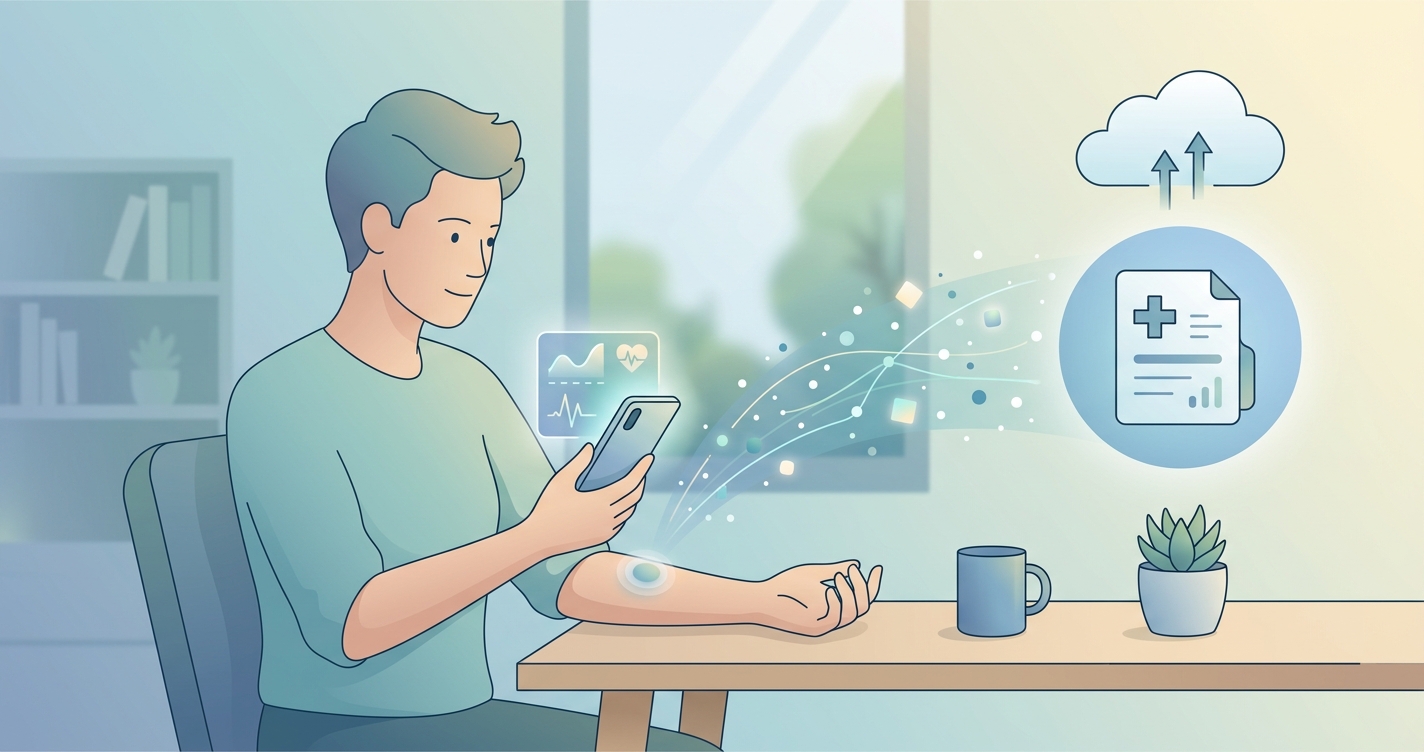
Patients almost never ask about FHIR resources, message brokers, or flowsheet mapping. They ask a far simpler question: how do I share health numbers with my doctor without learning yet another app, password, and login flow? For the health IT directors and EHR integration teams who design these pipelines, that question is the real specification. Every gram of friction a patient experiences at the point of capture becomes a gap in the dataset, a missed reading, and ultimately an unbillable month. The engineering challenge is not moving data once it exists. It is collecting clean patient-generated health data (PGHD) from people who have no interest in technology at all, and routing it into the record without anyone touching a keyboard.
A 2023 study by Khairat and colleagues found that only 30 percent of individuals in low-income communities used remote patient monitoring, 15 percent used medical apps, and 14 percent used wearables, with race, education, and income strongly associated with usage. The adoption gap is a workflow problem before it is a clinical one.
What it really takes to share health numbers with a doctor
When a patient wants to share health numbers with their doctor, three things have to happen in sequence: the reading must be captured, transmitted, and reconciled into the EHR under the correct patient and observation type. Most failure modes that IT teams see in production happen at step one. If the capture method requires a separate app download, account creation, Bluetooth pairing, or manual transcription, a measurable share of the patient population drops out before any data is generated.
A systematic review published in JAMIA Open on PGHD and EHR integration described the same pattern from the institutional side: data quality, usability, and inconsistent patient adherence are the dominant barriers, not the existence of an interoperability standard. FHIR solves the transport question. It does not solve the human one. The integration team's job is to choose a capture model whose friction profile matches the actual patient, then ensure whatever comes off that device lands as a structured Observation rather than a scanned PDF or a free-text note.
The practical design principle is to push complexity toward the backend, where engineering control exists, and away from the patient, where it does not. A patient should be able to take a reading the way they take their temperature, and the burden of identity, encoding, and routing should be invisible to them.
Comparison: how patients can share readings, ranked by friction
The methods below are ordered roughly from highest to lowest patient burden. The right choice depends on the population, but the integration cost and data quality differ sharply.
| Method | Patient effort | Data structure on arrival | IT integration cost | Adherence risk |
|---|---|---|---|---|
| Manual entry into a portal or app | High (login, typing) | Structured but error-prone | Low | High |
| Standalone wearable with companion app | High (pairing, charging, app) | Structured via vendor API | Medium | High |
| Cellular-connected peripheral device | Low (just measure) | Structured, device-tagged | Medium to high | Low |
| Camera or contactless scan on existing device | Very low (point and hold) | Structured via FHIR Observation | Medium | Low |
| Phone, fax, or message to staff | Low for patient, high for staff | Unstructured, manual re-entry | Low | Medium |
A few observations that matter for procurement and architecture:
- Manual portal entry has the lowest integration cost but the worst data quality and adherence, which makes it deceptively expensive over a program's life.
- Cellular and contactless methods cost more to integrate but remove the most common dropout points, since the patient does nothing but take the measurement.
- Any method that ends in staff re-keying a phoned-in number reintroduces transcription error and consumes the clinical labor RPM was meant to save.
Industry applications for low-friction data sharing
Chronic disease programs
Hypertension, diabetes, and heart failure programs depend on daily or near-daily readings to qualify for CMS reimbursement thresholds and to catch deterioration early. These populations skew older, and a 2024 PGHD review noted that device discomfort and improper setup directly reduce both compliance and data accuracy. Low-friction capture methods that require no pairing or charging tend to sustain the reading cadence these programs need.
Post-discharge and transitional care
In the 30 days after discharge, the goal is preventing readmission, and the enrollment window is short. Any onboarding step that requires an app store, a new account, or a support call delays the first reading past the point of clinical usefulness. Capture models that work on a device the patient already owns shorten time-to-first-reading dramatically.
Multi-vendor and value-based networks
Large networks rarely standardize on one device. The integration team's task is normalizing heterogeneous inputs into a single Observation schema. This is precisely where FHIR-native data, tagged with device provenance and LOINC codes at the source, reduces the reconciliation burden compared with proprietary payloads that each need a custom adapter.
Current research and evidence
The evidence base points consistently in one direction: outcomes improve when the data actually arrives, and the data arrives when capture is easy. A systematic review by Thomas and colleagues on RPM interventions reported improvements in patient safety, adherence, and cost-related outcomes including fewer emergency visits and lower 30-day readmissions, while flagging usability as a moderating factor. The benefit is real but conditional on engagement.
The usability dimension has matured into its own research thread. A Remote Patient Monitoring Usability Impact Model published in 2023 argued that user-centered design is not a cosmetic concern but a determinant of data validity, because poor setup produces both non-adherence and inaccurate measurements. For integration teams, the takeaway is that the device selection decision is also a data-governance decision.
On the institutional side, AHRQ's practical guidance for integrating patient-generated digital health data into ambulatory EHRs emphasizes workflow fit over technical novelty. Their EHR vendor survey work found that integration succeeds when PGHD enters existing clinical review workflows rather than a parallel inbox clinicians have to remember to check. In other words, the patient-facing simplicity and the clinician-facing simplicity are the same problem viewed from two ends.
The equity research adds urgency. The Khairat 2023 findings on underserved communities show that complexity does not just lower averages, it widens disparities. A capture model that assumes a recent smartphone, reliable broadband, and app fluency systematically excludes the patients who often have the most to gain from remote monitoring.
The future of sharing health numbers with a care team
Three shifts are already visible in how patients will share health numbers with doctors over the next several years.
- Capture is collapsing into devices people already own. Contactless and camera-based methods remove the cost and logistics of shipping, charging, and pairing hardware, which lowers both patient burden and program overhead.
- FHIR is becoming the default contract, not an upgrade. As US regulation continues to push standardized APIs, structured Observation data tagged at the source will replace the manual reconciliation pipelines that consume integration teams today.
- Ambient, passive collection will grow. The trajectory is toward measurement that happens during something the patient is already doing rather than as a separate daily task, which further reduces the adherence cliff.
The constant across all three is that the burden moves off the patient and onto well-instrumented backend systems. That is the correct place for it. The programs that win will be the ones whose patients never realize how much engineering sits behind a single reading.
Frequently asked questions
What is the easiest way for a patient to share health numbers with a doctor?
The lowest-friction methods require no app download, account, or device pairing. Cellular-connected peripherals and contactless camera-based scans let a patient take a reading and have it transmit automatically. From the IT side, the goal is to make the patient's only action the measurement itself, with identity, encoding, and routing handled invisibly.
Why do patients drop out of remote monitoring programs?
Most dropout happens at the capture step, not the clinical one. App logins, Bluetooth pairing, device charging, and manual transcription each remove a share of patients. Research on underserved populations shows complexity also widens disparities, so simpler capture both improves average adherence and broadens access.
How does this patient-generated data get into the EHR cleanly?
The reliable path is structured data tagged at the source with the correct observation type and device provenance, then mapped to FHIR Observation resources and routed into the clinician's existing review workflow. Methods that end in staff re-keying a phoned-in number reintroduce transcription error and should be avoided where possible.
Does easier data sharing affect reimbursement?
Yes. CMS RPM codes depend on meeting reading-day thresholds. Because adherence drives whether a program hits those thresholds, the friction of the capture method has a direct effect on billable months. Low-friction capture protects both data quality and revenue.
Circadify is building toward this exact problem space: low-friction, patient-side capture that arrives as HL7 FHIR-compatible vital signs data your team can route into existing EHR and telehealth workflows without a parallel inbox or a custom adapter for every device. Integration documentation and EHR implementation guides are available at circadify.com/solutions/telehealth.