Is there a simple way to take my pulse and share it with my doctor from my phone?
How to take pulse from phone and route it to your doctor through FHIR-based RPM workflows. A look at smartphone PPG accuracy and EHR integration.
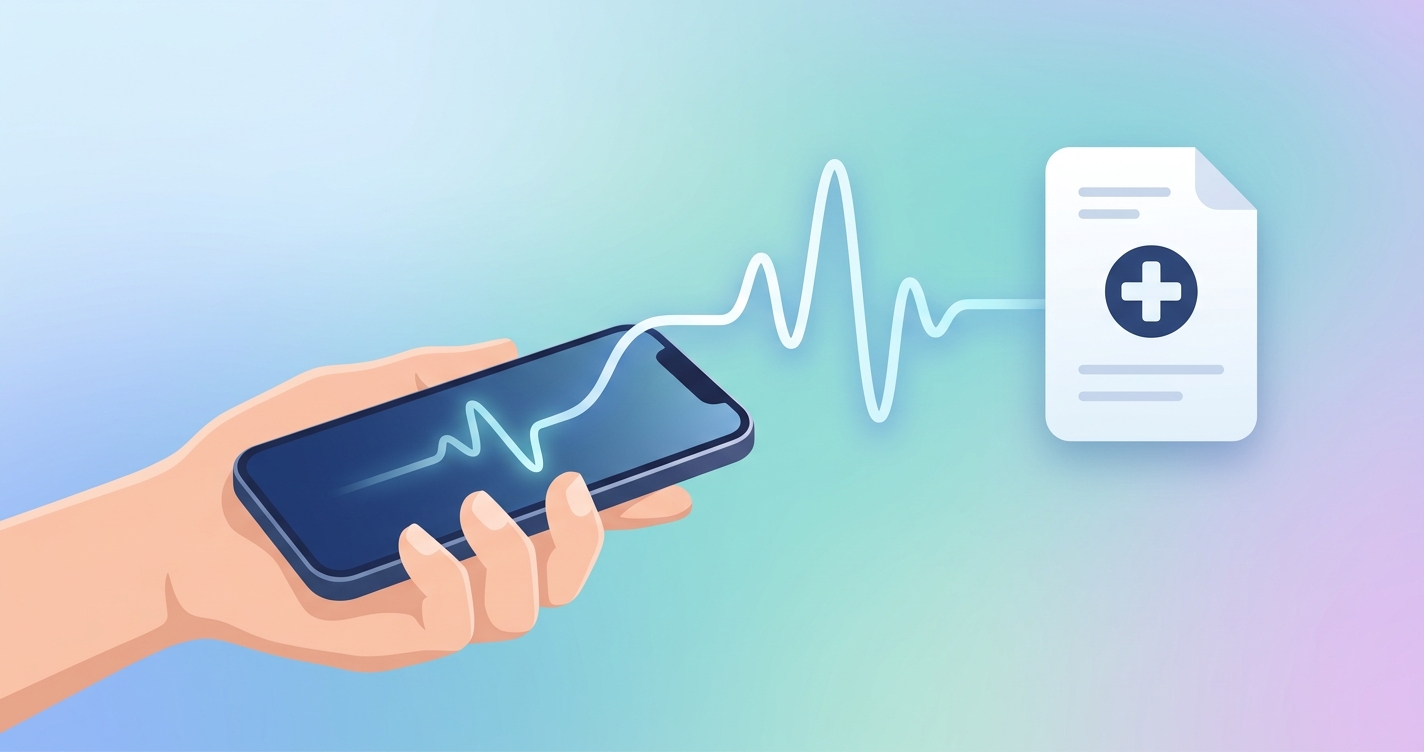
Patients enrolled in remote monitoring almost never ask about message brokers or resource mapping. They ask whether they can take pulse from phone and have the number show up where their clinician can act on it. For telehealth operations and EHR integration teams, that plain question hides a meaningful design decision. The smartphone is already in nearly every patient's pocket, equipped with a camera, a flashlight, and a network connection. The technical work is not convincing a patient to buy hardware. It is building the pipeline that turns a 30-second camera reading into a structured, billable, clinically usable observation inside the chart.
A passive heart rate monitoring system using a smartphone's front-facing camera achieved a mean absolute percentage error of 6.09 percent after confidence gating, with error under 10 percent across all skin tones, according to Google Research (2024).
How patients take pulse from phone and what reaches the EHR
When a patient places a fingertip over the rear camera and flash, the phone records subtle color changes in the skin caused by each heartbeat. This is contact-based photoplethysmography, or PPG. The app translates the optical signal into a pulse rate. A scoping review published in Frontiers in Cardiovascular Medicine (2023) found that contact-based smartphone PPG shows good to very strong agreement with electrocardiography for resting heart rate in healthy adults under controlled conditions, though the authors stressed that acquisition conditions and reporting standards vary widely between apps.
For an integration team, the measurement is only the first link. The harder part is the journey from app to chart. A heart rate captured on a phone has clinical value only if it arrives as a discrete, coded data point that a care manager can chart, trend, and bill against. That means the reading needs to leave the device as a FHIR Observation resource, carry the right LOINC code for heart rate, include a timestamp and patient reference, and land in the same flowsheet a nurse already reviews. When that path works, the patient experiences a one-tap action and the clinician sees a normal vital sign in a familiar place.
The distinction below matters because the patient-facing simplicity and the back-end engineering are two separate problems that teams often conflate.
| Dimension | Patient experience | Integration reality |
|---|---|---|
| Hardware | Existing smartphone, no new device | No procurement, but device and OS fragmentation to manage |
| Capture method | Fingertip on camera, ~30 seconds | Contact PPG signal processing, confidence scoring |
| Output | A number on screen | FHIR Observation with LOINC 8867-4, UCUM units |
| Transport | Tap "send to doctor" | API auth, encryption in transit, queueing |
| Destination | "My doctor sees it" | Flowsheet mapping, reconciliation, alert rules |
| Billing | Invisible to patient | Data must support CMS RPM documentation |
Why the smartphone is attractive for remote monitoring workflows
The appeal for telehealth operations is largely about reducing friction at enrollment and improving data capture rates. Programs that depend on shipped cellular cuffs and pulse oximeters carry logistics costs, device loss, and onboarding calls. A phone-based pulse check removes much of that overhead for the subset of measurements a camera can reasonably capture.
- No device kitting, shipping, or return logistics for the pulse data stream
- Lower onboarding burden because patients already know how to use their phone
- Higher measurement frequency when the barrier is a single tap rather than locating a peripheral
- Built-in connectivity that avoids Bluetooth pairing failures common with separate sensors
- A natural fit for digitally engaged patients who resist carrying extra equipment
These advantages do not make the phone a universal replacement for medical-grade peripherals. They make it a strong option for specific cohorts and specific measurements, particularly resting heart rate and rhythm screening, where the evidence base is strongest.
Industry Applications
Telehealth intake and triage
A pulse captured before a video visit gives the clinician objective context at the moment of the encounter. When the reading flows in as a FHIR Observation ahead of the appointment, the provider opens the chart with a current vital already populated rather than asking the patient to describe how they feel. This shortens visits and supports more consistent documentation.
Chronic care and rhythm surveillance
Real-world validation work published in EP Europace (2024) reported smartphone PPG sensitivity of 98.3 to 99.0 percent and specificity of 99.4 to 99.9 percent for detecting atrial fibrillation and flutter in unsupervised settings. For programs managing patients with known or suspected arrhythmia, phone-based pulse and rhythm checks can supplement structured monitoring between clinic visits, feeding the same care management platform that handles cuff and oximeter data.
EHR data acquisition at scale
For integration teams, the phone is a data source that behaves like any other RPM input once it is normalized. The Personal Health Device Implementation Guide and the broader FHIR vital signs profiles give a consistent target so that a heart rate from a phone, a wearable, or a Bluetooth peripheral all resolve to the same Observation structure. That uniformity is what lets a single reconciliation pipeline and a single set of alert rules cover multiple capture methods.
Current research and evidence
The accuracy picture is encouraging but conditional. The Google Research team (2024) reported resting heart rate performance comparable to wrist wearables, with mean absolute error under five beats per minute. The Frontiers scoping review (2023) confirmed strong agreement with ECG for resting measurements while cautioning that contact-based apps generally outperform non-contact approaches, and that motion, lighting, and device variation degrade results.
Two limitations deserve explicit attention from any team deploying this in production:
- Skin tone bias has been documented in remote PPG, where higher melanin concentration reduced accuracy in earlier models. Newer confidence-gated systems narrow but do not eliminate this gap, so validation across representative populations is essential.
- Rate underestimation during atrial fibrillation has been observed, with some studies reporting PPG undercounting higher heart rates by roughly 6.6 beats per minute. This argues for treating phone pulse data as a screening and trending signal rather than a diagnostic substitute.
On the integration side, the 2024 State of FHIR Survey from Firely documented continued growth in FHIR adoption across provider and vendor organizations, reinforcing that the Observation resource is the practical lingua franca for routing vital signs into the EHR. Published case work, including a Garmin-to-FHIR interoperability study in PMC (2024), demonstrates repeatable patterns for transforming consumer device data into FHIR Observations for the European Health Data Space, and those same patterns apply to smartphone-sourced pulse data.
The Future of taking your pulse from your phone
The trajectory points toward measurement that fades into the background. Passive monitoring, where the phone estimates heart rate during ordinary use rather than during a deliberate check, is moving from research into early products. For integration teams this raises new questions about consent, sampling frequency, and how to avoid flooding the chart with low-value data points. The discipline that solved alert fatigue for cuff readings will need to extend to a far higher-volume passive stream.
Expect three shifts over the next few years. First, confidence scores will travel with the reading so clinical systems can filter low-quality measurements automatically before they reach a flowsheet. Second, multi-parameter capture from a single camera session, pairing pulse with respiratory rate or rhythm classification, will increase the value of each interaction. Third, standards bodies will tighten guidance on how device-derived and self-measured observations are labeled, so clinicians can distinguish a phone estimate from a validated peripheral at a glance. None of these changes the core integration mandate: capture cleanly, normalize to FHIR, reconcile against other sources, and surface only what is clinically actionable.
Frequently asked questions
Is a pulse taken from a phone accurate enough for clinical use?
For resting heart rate in cooperative patients, peer-reviewed studies report strong agreement with ECG and error under five beats per minute in leading systems. It performs well as a screening and trending tool. It is not a validated replacement for diagnostic-grade measurement, particularly during arrhythmia or with motion, so most programs use it alongside other inputs rather than as the sole source.
How does the reading actually get into our EHR?
The app converts the pulse into a structured FHIR Observation with the appropriate LOINC code, units, timestamp, and patient reference. That resource is transmitted over an authenticated, encrypted API to your integration layer, mapped to the correct flowsheet, reconciled against other data, and made available to alert and billing logic. The patient sees a single send action.
Does phone-captured pulse data support CMS RPM billing?
It can, provided the data is captured by a qualifying process, stored as discrete time-stamped readings, and documented through your standard RPM workflow. The technical requirement is that each reading is a structured observation your billing automation can reference, not a free-text note or an image.
What patient populations is this best suited for?
Digitally engaged patients managing conditions where resting heart rate and rhythm trends matter benefit most, since the single-tap workflow drives higher measurement frequency. Patients who need continuous monitoring or measurements a camera cannot capture still require dedicated peripherals.
For telehealth operations and EHR integration teams evaluating how phone-based pulse capture fits an existing remote monitoring program, the deciding factor is whether the data arrives as clean, FHIR-native observations that drop into current workflows without custom rework. Circadify is building toward exactly that integration layer, with HL7 FHIR compatible RPM data designed to plug into your telehealth and EHR stack. Explore the integration docs and EHR guides at circadify.com/solutions/telehealth.