Why didn't my nurse get the readings I took this morning?
A deep dive into the data sync and reconciliation issues that prevent RPM readings from reaching the EHR, and how modern integration patterns can solve it.
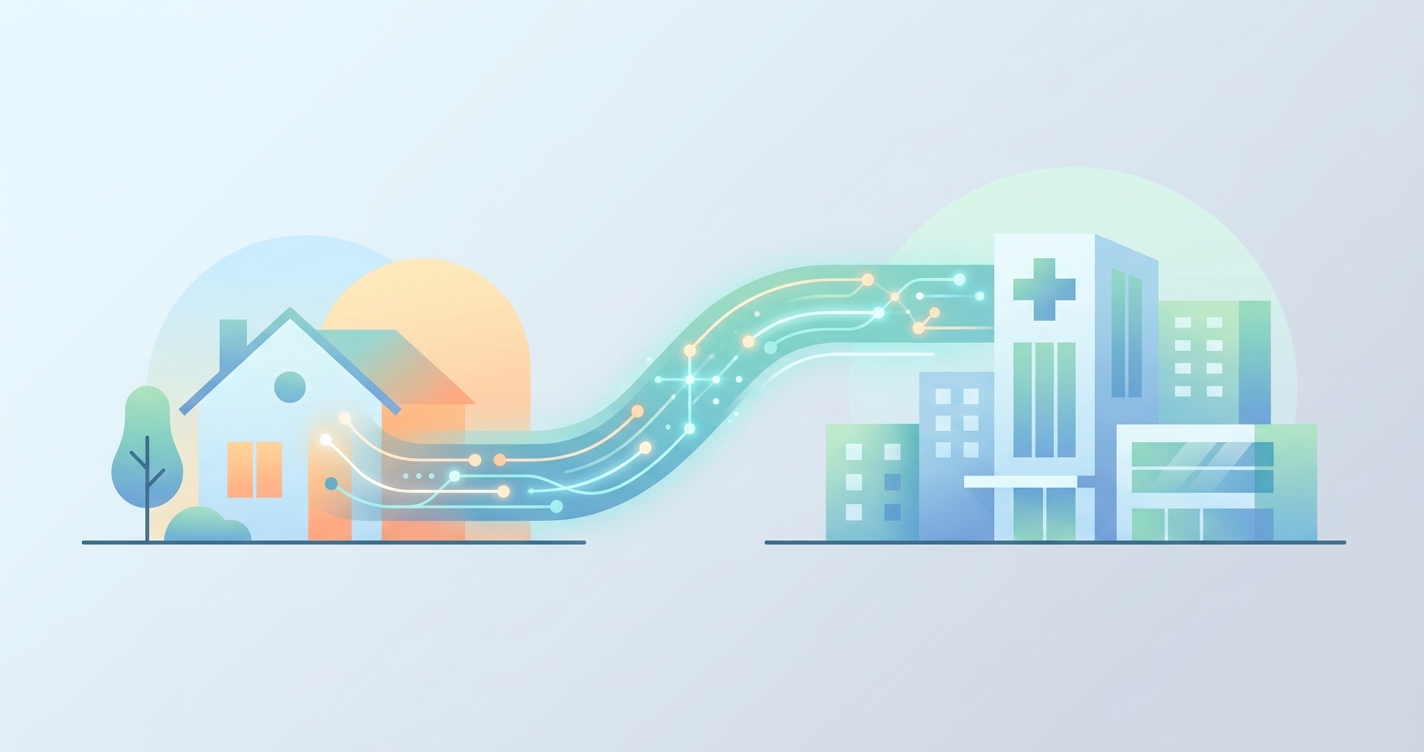
For a patient diligently taking their vital signs at home, the expectation is simple: the data will be reviewed by their clinician. When this fails, it erodes confidence In the remote patient monitoring (RPM) program. In the care process itself. For health IT and telehealth operations leaders, the question "Why didn't my nurse get the readings?" points to a critical infrastructure challenge. The problem of home readings not reaching care team members is rarely about patient error or device malfunction. Instead, it's typically a symptom of data synchronization and reconciliation failures within the health system's technology stack. Understanding the journey of a single data point from the patient's home to the electronic health record (EHR) reveals the numerous points where this journey can be interrupted.
"Between 2019 and 2023, remote patient monitoring services in the United States increased by over 3,334%, with payments increasing by 2,887%. This exponential growth in data volume places immense strain on legacy integration methods, making data reconciliation a primary operational focus." - (Based on research from the National Institutes of Health, 2023)
The data reconciliation gap in RPM
The core issue preventing vital signs from appearing in a patient's chart is a gap between data collection and data integration. An RPM platform may successfully receive a blood pressure reading from a cellular-enabled cuff, but its journey is far from over. That discrete piece of data must then be identified, authenticated, formatted, and transmitted to the clinical team's primary workspace-the EHR. This last mile of data delivery is where failures often occur. Without a robust, standardized pipeline, home readings not reaching care team dashboards become a common and frustrating reality. This breakdown is often invisible to the RPM vendor and the patient, but acutely felt by clinicians and IT staff who must manually investigate and resolve discrepancies, if they are even detected. This manual effort is not scalable and introduces a significant risk of clinical oversight.
| Data Transfer Method | Reliability | Scalability | EHR Integration Fidelity |
|---|---|---|---|
| Manual Data Entry | Low | Very Low | Prone to errors; lacks metadata |
| Proprietary API/SDK | Medium | Medium | Vendor-locked; requires maintenance |
| Batch File Upload (CSV/HL7v2) | Medium-High | Medium | Latency issues; not real-time |
| HL7 FHIR API Integration | High | High | Near real-time; standardized |
- Data Silos: The RPM platform and the EHR exist as separate systems. Without a seamless bridge, data remains trapped in the monitoring platform, inaccessible within the clinical workflow.
- Lack of Interoperability: Proprietary data formats from different device manufacturers require custom engineering for each new device type. This approach is brittle and expensive to maintain.
- Authentication & Mapping Errors: The process of matching an incoming reading to the correct patient in the EHR can fail. This is especially true in complex health systems with multiple patient identifier domains.
- Network Latency and Failures: The data must traverse multiple networks. A failure at any point-from the patient's home network to the cloud vendor hosting the RPM platform or the hospital's own internal network-can result in data loss.
Industry applications for seamless data flow
Addressing the challenge of lost readings requires a focus on modern integration architecture. Health IT leaders are increasingly moving away from brittle, point-to-point integrations and toward a more resilient, standards-based approach.
Adopting FHIR for vitals data
The HL7® Fast Healthcare Interoperability Resources (FHIR®) standard has become the consensus framework for this new architecture. As of 2023, reports from KLAS Research indicate that over 80% of U.S. hospitals are using FHIR APIs, driven by mandates in the 21st Century Cures Act. By defining a common, web-based language for healthcare data, FHIR provides a predictable and reliable method for an RPM platform to post vital signs directly to an EHR.
Using integration engines
An integration engine acts as a central hub for all data traffic, including RPM. It can receive data from multiple RPM vendors, transform it into the appropriate FHIR format (specifically, the Observation resource), and route it to the correct EHR endpoint. This hub-and-spoke model simplifies management and monitoring.
Implementing reconciliation workflows
Automated reconciliation is key. This involves creating workflows that continuously check for data consistency between the RPM platform and the EHR. If a discrepancy is found-for example, an RPM platform shows 10 readings for a patient but the EHR only has 9-an alert is automatically generated for the IT team to investigate.
Current research and evidence
The shift to standardized data exchange is well-documented. A systematic review published in the Journal of Medical Internet Research analyzed multiple studies on FHIR implementation, concluding that it significantly reduces the complexity and cost of integration projects. Researchers noted that while initial setup requires expertise, the long-term benefits of a maintainable and scalable infrastructure are substantial.
Further analysis in 2023 by industry bodies has focused on the Total Cost of Ownership (TCO) for RPM integration. The findings suggest that while direct API integrations using FHIR have a higher initial development cost compared to methods like CSV uploads, the TCO over 3-5 years is significantly lower due to reduced manual intervention, fewer data errors, and greater flexibility to add new monitoring devices. The data integrity provided by FHIR is not just an IT benefit; it directly supports clinical quality by ensuring the data clinicians see is timely and complete.
The future of RPM data integration
The future of RPM data management lies in complete automation and what is often termed "lights-out" data processing. The goal is for a reading to flow from a patient's device to their chart without any human intervention. This requires not just FHIR APIs, but a comprehensive strategy that includes robust error handling, automated alerting for system-level issues, and sophisticated data validation rules. As AI and machine learning models are increasingly used to analyze RPM data for trends, the need for pristine, well-structured data from the source becomes even more critical. Systems that cannot guarantee the delivery and accuracy of data will be unable to support these advanced clinical decision support tools.
Frequently asked questions
Q: Is the RPM device company or the EHR vendor responsible for fixing this?
A: Responsibility is often shared. The issue is typically in the integration layer between the two systems. A successful RPM program requires a clear delineation of responsibility for data transmission, which is why a robust integration engine and standardized protocols like FHIR are so important. They create a clear contract between systems.
Q: How can I tell if our 'home readings not reaching care team' problem is due to technology or workflow?
A: Start by auditing the data flow. Can you confirm the RPM platform received the reading? If yes, the issue is downstream. From there, check the integration logs. Are there API errors? Are patient identifiers mismatched? This forensic approach will pinpoint if it's a technical failure (e.g., a network timeout) or a workflow issue (e.g., the reading was received but not directed to the correct clinician view in the EHR).
Q: We have multiple RPM vendors. Does that make this problem harder to solve?
A: Yes, a multi-vendor environment exacerbates the data reconciliation challenge. Each vendor may have a different data format and delivery method. This is the ideal use case for an integration platform that can normalize data from all sources into a single, consistent FHIR-based stream before delivering it to the EHR.
Circadify is at the forefront of solving these complex integration challenges, providing a technology stack that ensures data from any RPM source is reliably delivered to your clinical teams. By using HL7 FHIR standards, our solutions plug directly into existing EHR and telehealth workflows, eliminating data silos and ensuring the data you need is where you need it. To learn more about building a scalable and resilient RPM data infrastructure, explore our integration guides at circadify.com/solutions/telehealth.