Why does my clinic ask me to take vitals at home every day?
A look into the operational and clinical shift towards daily home vitals and remote patient monitoring (RPM) and how this data reaches provider dashboards.
The question of why a clinic asks patients to measure vital signs at home every day marks a fundamental shift in healthcare delivery. It signals a transition from episodic, in-person appointments to a model of continuous, proactive care management. For health systems, this isn't just about patient convenience; it's a strategic move to use objective physiological data at scale. The operational backbone of this model is daily home vitals remote patient monitoring (RPM), a system designed to capture, transmit, and analyze health metrics from patients' homes, integrating them directly into clinical workflows and provider dashboards. This allows care teams to identify and manage exacerbations before they become acute events, improving outcomes and operational efficiency.
"A 2022 meta-analysis covering over 100,000 patients found that remote patient monitoring programs were associated with a 25% reduction in hospital readmissions for common chronic conditions."
The technical framework of daily home vitals remote patient monitoring
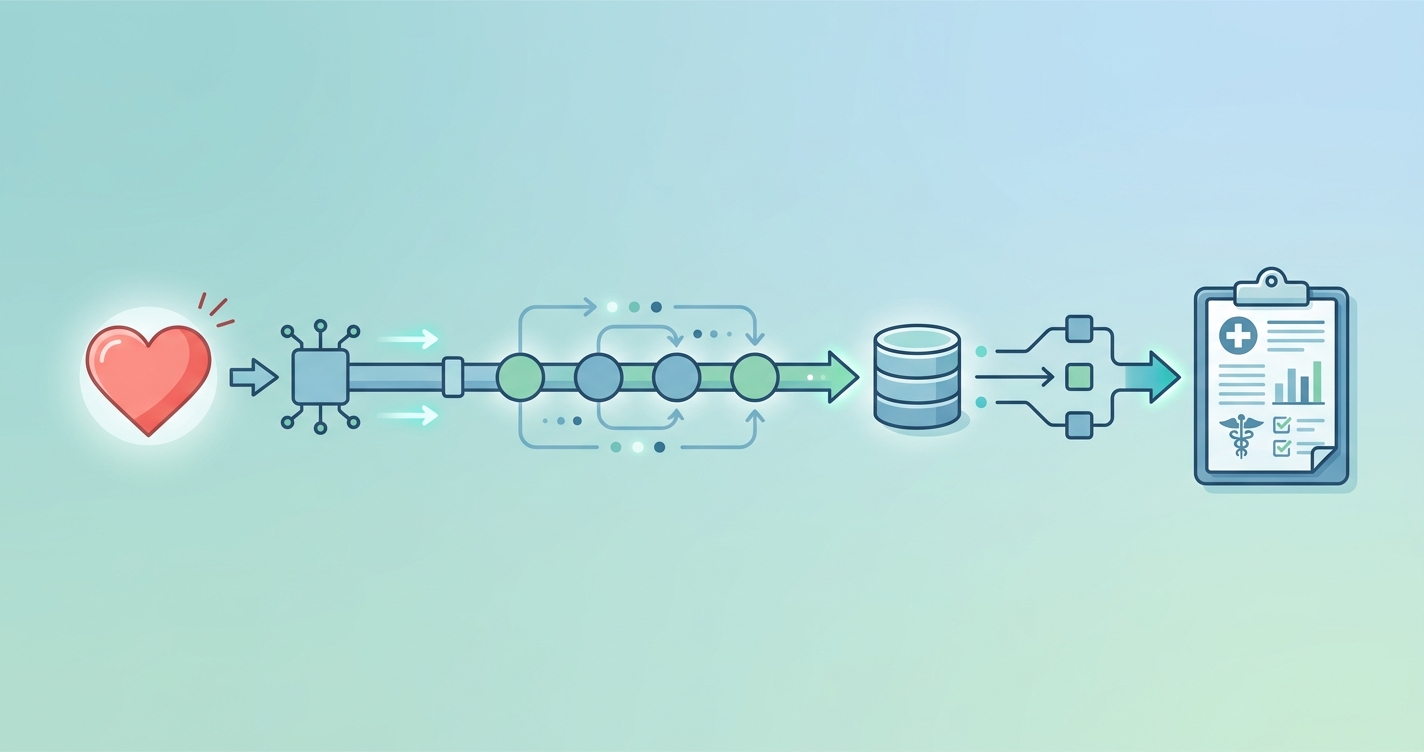
The request for daily vital signs is the front-end of a complex health data workflow. From a Health IT perspective, the challenge is to make the process of collecting, transmitting, and integrating this data seamless, secure, and clinically valuable. When a patient takes a reading at home, be it blood pressure, glucose levels, or weight, that data point begins a journey that must end in an actionable format within the provider's primary workspace, typically the Electronic Health Record (EHR).
The success of a daily home vitals remote patient monitoring program hinges on its data integration architecture. Initially, many systems relied on manual entry or proprietary, siloed platforms that created new work for clinical staff. Today, the industry standard is moving towards interoperable systems built on standards like HL7 FHIR (Fast Healthcare Interoperability Resources). A FHIR-based approach allows patient-generated health data to be transmitted as standardized 'Observation' resources. This means the data flows from the patient's device (or a connected app) through a secure gateway and is automatically filed into the correct patient chart in the EHR. This automated workflow is what allows clinicians to manage large patient populations effectively, with rules-based alerts flagging only those readings that fall outside of pre-defined parameters.
| Data Integration Method | Description | Pros | Cons |
|---|---|---|---|
| Manual Entry / Portal | Clinicians or patients manually type data into an EHR or a separate web portal. | Low initial technical barrier. | Prone to error, inefficient, not scalable, creates data silos. |
| Proprietary API | The RPM vendor provides a custom API to push data to the health system. | Can be tailored to specific needs. | Creates vendor lock-in, high development overhead, brittle connections. |
| HL7 FHIR Integration | Uses the modern healthcare data standard to structure and exchange data as 'Observation' resources. | High interoperability, EHR-native workflows, scalable, future-proof. | Requires FHIR-compatible systems or middleware, initial setup complexity. |
Industry Applications
The ability to pipe reliable, daily vitals from the home directly into the clinical workflow has unlocked several high-value use cases for health systems.
Chronic care management
For conditions like hypertension, diabetes, and heart failure, infrequent snapshots of data from office visits are insufficient. Daily readings provide a longitudinal view of a patient's condition, enabling clinicians to make more informed decisions about medication adjustments and lifestyle interventions. A collaborative study in 2023 by HealthSnap, Prisma Health, and Virginia Cardiovascular Specialists demonstrated significant improvements in blood pressure control through this model.
Post-Discharge Monitoring
The 30-day window after a hospital discharge is a high-risk period for readmissions. RPM programs are deployed to monitor patients' recovery, ensuring vital signs are stable and catching early signs of complications. This provides a safety net for the patient and helps hospitals reduce costly readmission penalties.
Hospital-at-Home Programs
A growing trend, "hospital-at-home" provides acute-level care in a patient's residence. These programs are critically dependent on robust, real-time daily home vitals remote patient monitoring to ensure patient safety and provide clinicians with the data parity they would have in an inpatient setting.
Current research and evidence
The clinical efficacy of RPM is well-documented. Beyond the readmission statistics, research points to specific operational and clinical benefits. A meta-analysis published in the journal Cureus in 2023, focusing on heart failure patients, found that RPM significantly reduced hospitalizations related to the condition. This research highlights the value of daily monitoring in managing complex patient populations.
From an industry perspective, a 2023 report from KLAS Research highlighted that while the market is crowded, health systems are maturing in their evaluations. They are moving past vendor promises and focusing on concrete metrics like the quality of EHR integration, the reliability of the data supply chain, and the ability to customize alerting to minimize clinical noise. This indicates a shift towards valuing the underlying data infrastructure as much as the patient-facing devices.
The future of home vitals monitoring
The technology behind RPM is rapidly evolving. The next frontier is the move towards more passive and contactless monitoring. Researchers are actively developing and testing ambient sensors, radar technologies, and camera-based solutions that can capture vital signs like respiratory rate, heart rate, and even blood pressure without requiring the patient to do anything.
- AI and Predictive Analytics: Machine learning algorithms are being trained on large RPM datasets to identify subtle patterns that precede a clinical event, shifting care from reactive to predictive.
- Contactless Sensing: As these technologies mature and gain regulatory approval, they will reduce the patient burden associated with traditional device-based monitoring. An article published in Sensors in early 2024 detailed multiple promising modalities for this.
- Deeper EHR Integration: Future standards like FHIR R6 (expected in 2026) promise to further enhance real-time data exchange and introduce new resource types for more complex data, such as alerts from the monitoring devices themselves.
Frequently asked questions
Q: How does this vitals data actually get into our EHR? A: Typically, it flows from the patient's measurement device via a cellular or Bluetooth connection to the RPM platform's cloud. From there, a middleware engine transforms the data into a standardized HL7 FHIR Observation resource, which is then sent via a secure API endpoint directly to your EHR, where it is automatically matched to the patient's chart.
Q: Can we customize the alert parameters for different patient groups? A: Yes. A core function of modern RPM platforms is the ability to configure rules-based alerts. Health IT and clinical leadership teams can set specific thresholds for different conditions, care programs, or even individual patients. The goal is to ensure that clinicians are only alerted to clinically significant deviations, reducing alert fatigue.
Q: What is the operational lift for our IT team to integrate a new RPM system? A: With a FHIR-native platform, the lift is significantly reduced compared to legacy methods. The primary tasks involve configuring a secure API endpoint, mapping the incoming FHIR resources to the appropriate fields in your EHR (like Flowsheets), and conducting validation testing. The use of a standardized protocol like FHIR eliminates the need for extensive custom development.
The implementation of daily home vitals monitoring is a clear indicator that healthcare is moving towards a more connected and data-driven future. For health systems, the key to success is choosing a technology partner that understands the complexities of clinical workflow and data integration. To learn more about building a scalable RPM data infrastructure that plugs into your existing workflows, explore Circadify's solutions for telehealth and EHR integration at circadify.com/solutions/telehealth.