Why do I need to send my blood pressure to my doctor when I feel fine now?
Why monitor blood pressure at home even when you feel well? A look at masked hypertension, trend detection, and how RPM data flows into EHR workflows.
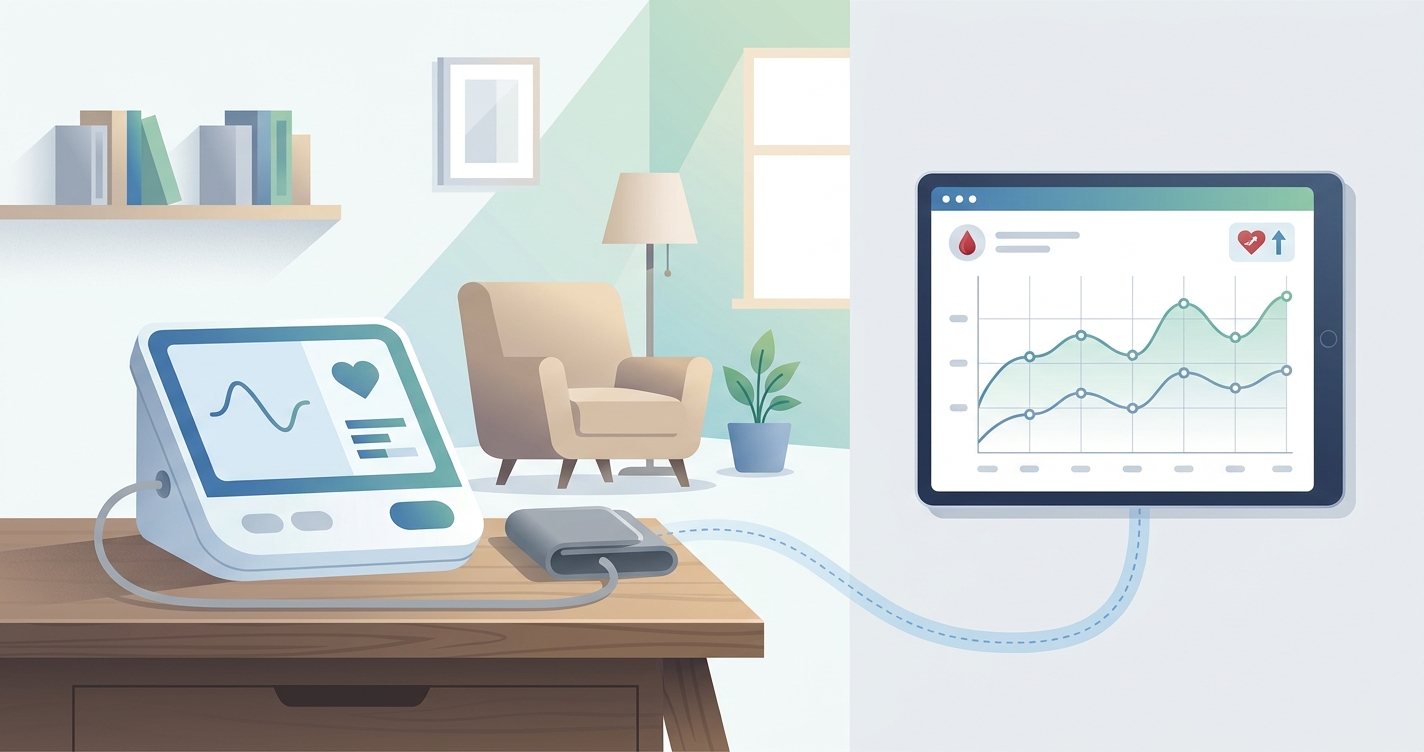
Feeling fine is one of the least reliable signals in cardiovascular care. High blood pressure earns its reputation as a silent condition precisely because it produces no day-to-day sensation until damage has already accumulated in the heart, kidneys, eyes, or brain. That is the gap that home monitoring is built to close. If you have ever wondered why monitor blood pressure at home when nothing feels wrong, the short answer is that your subjective sense of wellness and your actual vascular pressure are often two completely different stories. For the telehealth operations and EHR integration teams reading over a patient's shoulder, this question is also an architecture question: how do you turn a single reassuring reading into a defensible, longitudinal record that improves preventative care?
"Out-of-office blood pressure measurements obtained through home or ambulatory monitoring are better predictors of cardiovascular events than readings taken in the clinic," notes the American Heart Association in its 2025 hypertension guideline, which sets a treatment target of less than 130/80 mm Hg for most adults.
Why monitor blood pressure at home: the data the office visit misses
A blood pressure reading taken once or twice a year in an exam room is a snapshot. It captures one moment, often while you are slightly stressed, recently caffeinated, or rushing in from a waiting room. The decision to monitor blood pressure at home exists because cardiovascular risk is a pattern, not a point. A patient can feel completely well and still carry a pressure trend that, left unobserved, quietly raises the odds of stroke and heart failure.
The clearest argument comes from masked hypertension, a condition in which office readings look normal but out-of-office readings are elevated. Research summarized in the National Library of Medicine literature places its prevalence between roughly 10 and 21 percent of people with normal clinic readings. A 2023 analysis of treated patients with controlled office pressure found isolated nighttime masked uncontrolled hypertension in as many as 34.9 percent of cases. These are people who would be told they are fine on the basis of an office visit alone, while their real risk profile stays invisible.
Home monitoring inverts the logic of the annual checkup. Instead of asking a patient to perform health on a single appointed day, it samples ordinary life: mornings before medication, evenings after dinner, weekdays and weekends. The result is a distribution rather than a data point, and distributions are where clinical trends actually live.
What "feeling fine" cannot tell you
- Blood pressure can sit well above target for years without producing noticeable symptoms.
- White-coat effects can make a single clinic reading higher than your true baseline, leading to overtreatment.
- Masked hypertension can make a single clinic reading lower than your true baseline, leading to undertreatment.
- Medication effectiveness changes over time, and a slow drift is invisible without repeated measurement.
- Early kidney or cardiac strain often shows up as a pressure trend long before it shows up as a feeling.
Comparing measurement approaches
Different ways of capturing blood pressure produce very different pictures of risk. The table below frames the trade-offs that matter both to patients and to the operations teams who have to move the resulting data into a care platform.
| Measurement approach | Data frequency | Catches masked or nighttime hypertension | Patient burden | Fits a continuous EHR record |
|---|---|---|---|---|
| Annual office visit | 1 to 2 readings per year | Rarely | Low per visit, high travel | Episodic, sparse entries |
| Symptom-triggered visit | Only when unwell | No, by definition | High and reactive | Gaps until a crisis |
| Home monitoring (manual log) | Daily or weekly | Sometimes | Moderate, error-prone | Manual transcription required |
| Connected home monitoring (RPM) | Daily, automatic | Often | Low and passive | Structured, continuous feed |
| Ambulatory 24-hour monitoring | Every 15 to 30 min for a day | Yes, including nighttime | High for a short window | One-time dataset |
The pattern is consistent: the approaches that best capture hidden risk are also the ones that generate the most data, which is exactly why the integration layer matters. A reading that never reaches the clinician, or arrives as an unstructured note, does not improve preventative care no matter how accurate the device.
Industry applications for telehealth and integration teams
The patient question, why send readings when I feel fine, has a direct operational counterpart for the teams who run remote monitoring programs. The value of continuous data is only realized when that data is collected reliably, structured consistently, and surfaced to the right clinician at the right time.
Turning passive collection into proactive care
Connected home monitoring lets a program observe trends across an entire panel without waiting for symptoms. A gradual upward drift in morning systolic readings, a widening gap between clinic and home values, or a cluster of elevated weekend measurements can each trigger outreach before a patient ever feels unwell. This is the preventative-care promise that operations teams are asked to deliver: intervention driven by data trends rather than by emergencies.
Structuring the data for the EHR
For a reading to inform care, it has to land in the record as something a clinician and a decision-support rule can both read. Mapping home blood pressure into standardized FHIR vital signs Observation resources, with consistent units, timestamps, and device provenance, is what separates a usable longitudinal record from a pile of disconnected numbers. A telehealth RPM workflow that writes structured, deduplicated readings into the EHR makes trend detection a query rather than a manual chart review.
Supporting reimbursement and program sustainability
Consistent data collection is also what makes remote monitoring financially viable. CMS RPM reimbursement is tied to documented device transmissions and qualifying interactive time, so the same continuous feed that protects the patient also substantiates the program. The infrastructure that captures, timestamps, and files each reading does double duty as clinical evidence and billing evidence.
Current research and evidence
The evidence base for monitoring before symptoms appear has matured considerably. The American Heart Association's 2025 guideline, developed with the American College of Cardiology and a coalition of professional societies, treats out-of-office measurement as a standard part of diagnosis and management rather than an optional extra. It recommends validated, automatic, upper-arm cuff devices and emphasizes that home and ambulatory readings predict cardiovascular events more accurately than clinic readings alone.
Earlier foundational work by Thomas Pickering and colleagues, whose AHA scientific statement on blood pressure measurement remains widely cited, established the case that single-setting readings systematically misclassify a meaningful share of patients. The masked hypertension literature compiled across multiple cohorts in the National Library of Medicine extends that point, showing that the people most likely to be missed are often those who feel and appear healthy. The 2023 finding that nighttime masked uncontrolled hypertension affects roughly a third of treated, apparently controlled patients reinforces how much risk hides outside the exam room.
The throughline across this research is that frequency and setting of measurement change conclusions about risk. More observations, gathered in ordinary conditions, reduce misclassification. That is the empirical foundation under every well-designed home monitoring program.
The future of home blood pressure monitoring
The direction of travel is toward measurement that asks even less of the patient while delivering even more to the clinician. Several shifts are already visible:
- Lower-friction capture, including cuffless and contactless approaches, aimed at increasing the number of readings a patient will actually take.
- Tighter EHR integration, where readings arrive as structured FHIR resources and flow directly into dashboards and decision-support logic.
- Smarter trend analytics that flag a meaningful drift rather than a single outlier, reducing alert fatigue for care teams.
- Closer alignment between clinical evidence and reimbursement documentation, so that the act of monitoring sustains the program that delivers it.
The destination is a model where preventative care runs on continuous signal rather than periodic snapshots, and where "I feel fine" is treated as a hypothesis to be checked against data rather than a conclusion.
Frequently asked questions
Why monitor blood pressure at home if my last clinic reading was normal?
Because a normal clinic reading is a single snapshot. Conditions like masked hypertension produce normal office values alongside elevated out-of-office values in an estimated 10 to 21 percent of people. Home readings sample your ordinary days and reveal trends that one appointment cannot.
Does sending readings when I feel fine actually change my care?
Yes. Continuous data lets a care team spot a gradual upward trend, a medication losing effectiveness, or a clinic-versus-home gap before symptoms appear. That is the basis of preventative intervention rather than reactive crisis care.
How does my home reading reach my doctor in a useful form?
In a well-built remote monitoring program, the device transmits the reading automatically into the electronic health record as a structured vital sign, with the time and device recorded. That lets clinicians and automated rules review trends without manual data entry.
Will I have to take readings forever?
Monitoring frequency is a clinical decision that changes with your stability and risk. The goal is enough data to detect meaningful change, not constant measurement for its own sake. Many programs adjust cadence as a patient's trend becomes well understood.
For health IT and telehealth operations teams building toward this model, the hard part is rarely the reading itself, it is moving that reading into the EHR as clean, structured, trend-ready data. Circadify is working on this space with HL7 FHIR compatible RPM data designed to plug into existing telehealth and EHR workflows. Explore the integration docs and EHR guides at circadify.com/solutions/telehealth.